O Levels/IGCSE Biology (5090)•5090/12/M/J/23
O Levels/IGCSE Biology (5090) — 5090/12/M/J/23, Question 13
A person who has celiac disease has flattened villi in their ileum. If a person with celiac disease eats the same quantity and type of food as a disease-free person, they will have lower level of glucose in the hepatic portal vein. Which explains this?
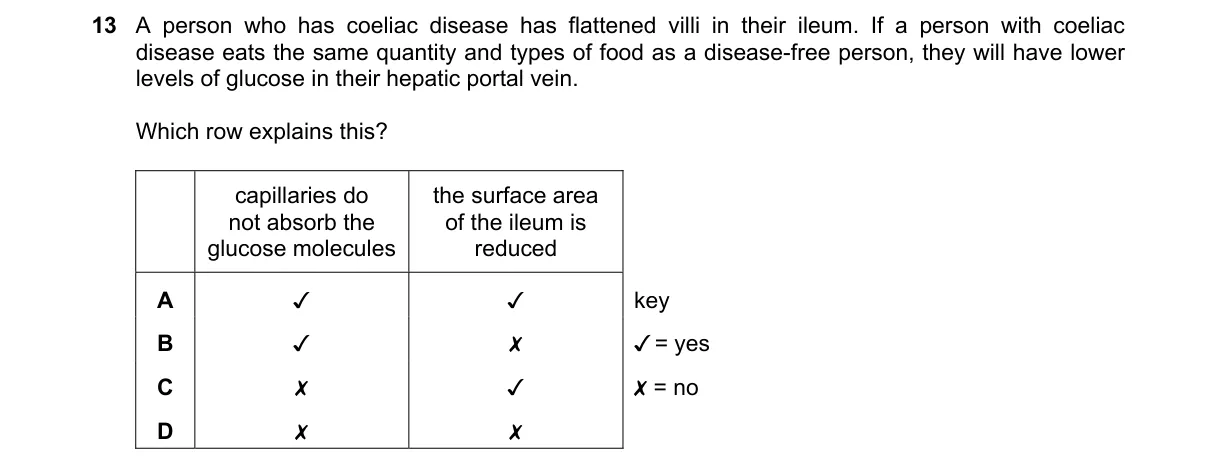
Answer choices
- Adoes not absorb glucose molecules: yes; the surface area of the ileum is: yes
- Bdoes not absorb glucose molecules: no; the surface area of the ileum is: no
- Cdoes not absorb glucose molecules: no; the surface area of the ileum is: yes
- Ddoes not absorb glucose molecules: yes; the surface area of the ileum is: no
Explanation
Flattened villi reduce ileum surface area but allow glucose absorption
Steps:
- Celiac disease damages villi, flattening them in the ileum and small intestine.
- Flattened villi decrease absorptive surface area, impairing nutrient uptake.
- Glucose absorption occurs via transporters in enterocytes, not solely dependent on villi projections.
- Reduced surface area leads to less glucose entering the hepatic portal vein despite same food intake.
Why C is correct:
- Flattened villi confirm reduced ileum surface area (yes), but glucose molecules are still absorbed via active transport (no block, so no).
Why the others are wrong:
- A: Wrongly claims no glucose absorption; transporters function despite flattened villi.
- B: Incorrectly denies both reduced surface area and absorption block; surface area is reduced.
- D: Erroneously states no glucose absorption; it occurs, just less efficiently.
Final answer: C
Topic: Absorption and assimilation
Practice more O Levels/IGCSE Biology (5090) questions on mMCQ.me