O Levels/IGCSE Biology (5090)•5090/12/M/J/22
O Levels/IGCSE Biology (5090) — 5090/12/M/J/22, Question 5
Amylase is an enzyme that breaks down starch to maltose. Students set up an experiment to investigate the effect of different temperatures on the action of amylase on starch solution. They measured the amount of starch remaining after 30 minutes at different temperatures. Which graph would you expect the students to draw from their results?
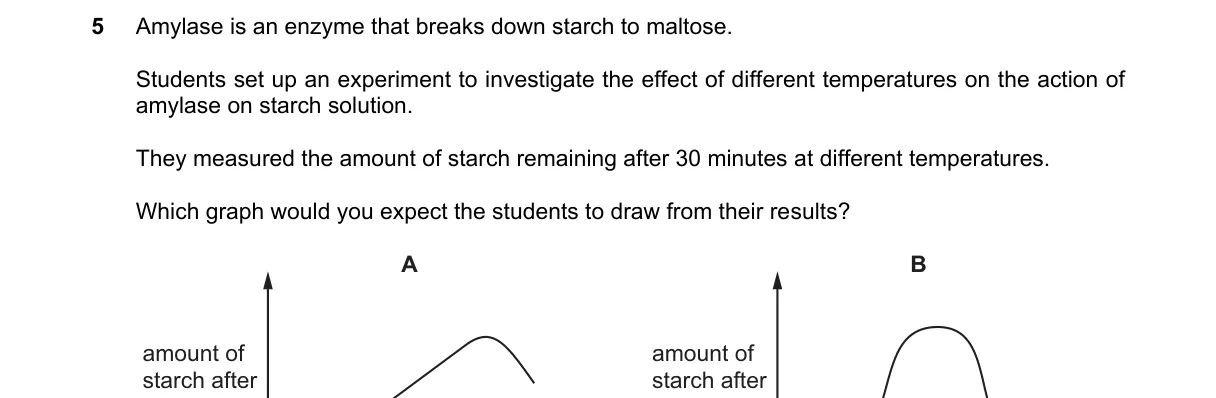
Answer choices
- AOption A
- BOption B
- COption C
- DOption D
Explanation
Temperature Optimum for Enzyme Activity
Steps:
- Enzymes like amylase function best at an optimal temperature, where reaction rate is highest.
- At low temperatures, activity is low, so much starch remains.
- Activity peaks at optimum temperature, minimizing remaining starch.
- Above optimum, enzyme denatures, reducing activity and increasing remaining starch.
Why C is correct:
- Graph C shows starch remaining high at low temperatures, lowest at optimum (~37°C for human amylase), then rising at high temperatures, matching enzyme denaturation principle.
Why the others are wrong:
- A: Linear decrease ignores denaturation rise.
- B: Steady decline overlooks optimal peak.
- D: Increase only reflects cold inactivity, misses optimum drop.
Final answer: C
Topic: Effects of temperature and pH
Practice more O Levels/IGCSE Biology (5090) questions on mMCQ.me