O Levels/IGCSE Biology (5090)•5090/11/M/J/22
O Levels/IGCSE Biology (5090) — 5090/11/M/J/22, Question 27
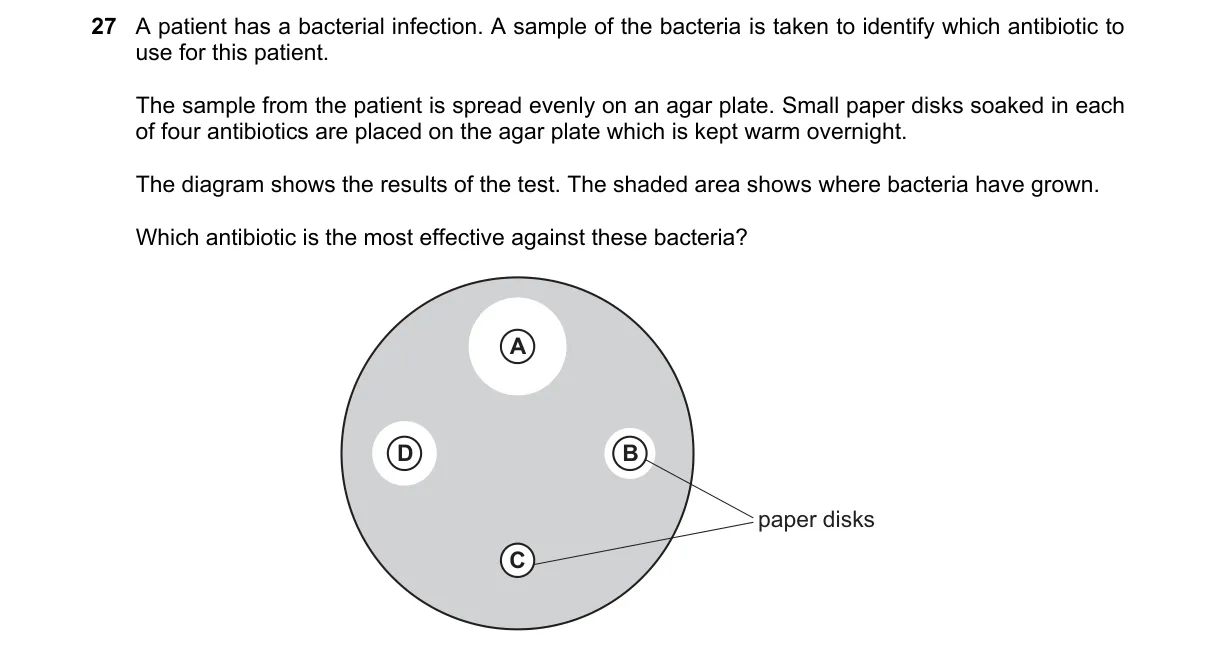
A patient has a bacterial infection. A sample of the bacteria is taken to identify which antibiotic to use for the patient. The sample from the patient is spread evenly on an agar plate. Small paper disks soaked in each of four antibiotics are placed on the agar plate which is kept warm overnight. The diagram shows the results of the test. The shaded areas show where bacteria have grown. Which antibiotic is the most effective against these bacteria?
Answer choices
- AOption A
- BOption B
- COption C
- DOption D
Explanation
Antibiotic effectiveness via zone of inhibition Steps:
- Observe the agar plate: shaded areas indicate bacterial growth, clear zones show inhibition by antibiotics.
- Measure clear zones around each disk: larger zones mean the antibiotic diffuses farther and kills more bacteria.
- Compare zones for antibiotics A, B, C, D: identify the largest clear area.
- Select the antibiotic with the widest inhibition zone as most effective.
Why A is correct:
- A shows the largest clear zone, indicating strongest bacterial inhibition per disk diffusion test principles.
Why the others are wrong:
- B has a smaller zone, allowing more bacterial growth nearby.
- C has minimal or no clear zone, showing little to no effectiveness.
- D permits bacterial growth up to or overlapping the disk, indicating resistance.
Final answer: A
Topic: Antibiotics
Practice more O Levels/IGCSE Biology (5090) questions on mMCQ.me