O Levels/IGCSE Biology (5090)•5090/12/M/J/21
O Levels/IGCSE Biology (5090) — 5090/12/M/J/21, Question 3
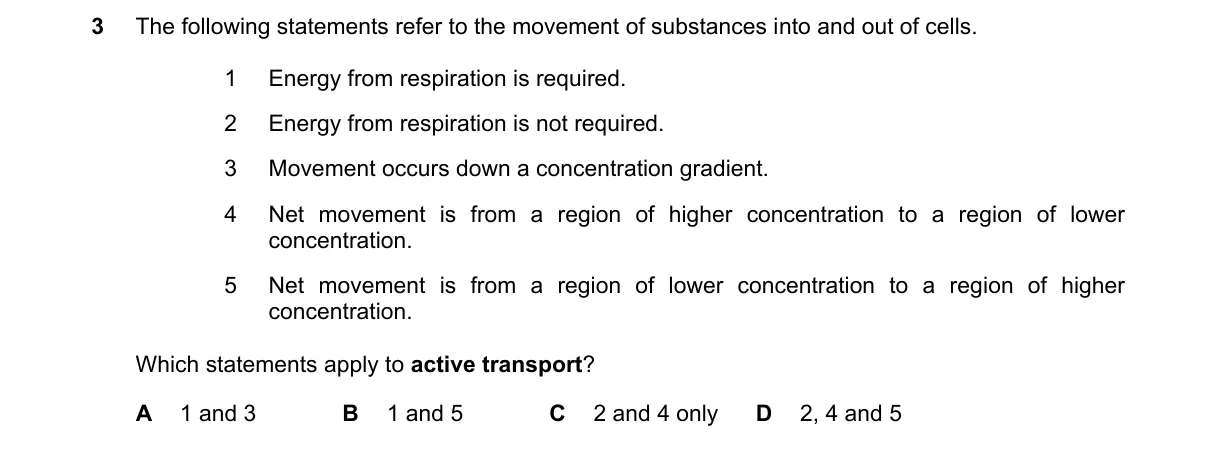
The following statements refer to the movement of substances into and out of cells.
1 Energy from respiration is required.
2 Energy from respiration is not required.
3 Movement occurs from a region of higher concentration to a region of lower concentration.
4 Movement occurs from a region of lower concentration to a region of higher concentration.
5 Movement is from a region of lower concentration to a region of higher concentration.
Which statements apply to active transport?
Answer choices
- A1 and 3
- B1 and 5
- C2 and 4 only
- D2 and 5
Explanation
Active Transport Requires Energy for Uphill Movement
Steps:
- Recall active transport definition: uses cellular energy to move substances against concentration gradient.
- Match statement 1: energy from respiration is required, which fits active transport.
- Match statement 5: movement from lower to higher concentration, defining active transport's direction.
- Eliminate statements 2, 3, 4: these describe passive processes like diffusion, not active transport.
Why B is correct:
- Active transport is defined as energy-dependent movement from low to high concentration, per cellular biology principles.
Why the others are wrong:
- A: Includes 3 (downhill movement), which is diffusion, not active transport.
- C: Includes 2 (no energy) and 4 (uphill but passive phrasing), both incorrect for active transport.
- D: Includes 2 (no energy required), contradicting active transport's energy need.
Final answer: B
Topic: Active transport
Practice more O Levels/IGCSE Biology (5090) questions on mMCQ.me