O Levels/IGCSE Biology (5090)•5090/12/M/J/21
O Levels/IGCSE Biology (5090) — 5090/12/M/J/21, Question 26
The diagram shows the structure of a bacterium. In what way does this differ from a cell of a fungus?
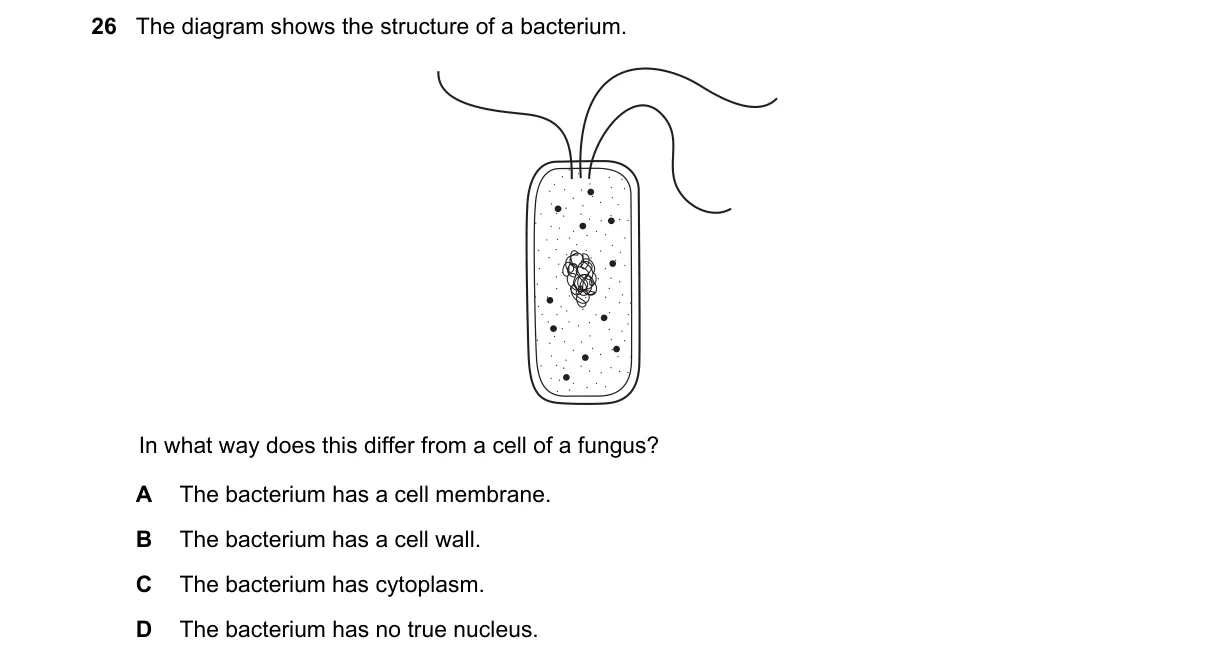
Answer choices
- AThe bacterium has cell wall.
- BThe bacterium has cytoplasm.
- CThe bacterium has no nucleus.
- DThe bacterium has true nucleus.
Explanation
Prokaryotic vs. Eukaryotic Cell Structure
Steps:
- Identify key features: Bacteria are prokaryotes; fungi are eukaryotes.
- Compare nucleus: Prokaryotes lack a membrane-bound nucleus; eukaryotes have one.
- Evaluate options: Check which highlights the nuclear difference.
- Select the mismatch: Bacterium lacks a true nucleus, unlike fungal cells.
Why C is correct:
- Bacteria are prokaryotic cells without a membrane-bound nucleus, while fungal cells are eukaryotic with a defined nucleus containing genetic material.
Why the others are wrong:
- A: Both bacteria and fungi have cell walls (bacterial: peptidoglycan; fungal: chitin).
- B: Both have cytoplasm as the fluid matrix for organelles and processes.
- D: Bacteria do not have a true nucleus; this describes fungal cells instead.
Final answer: C
Topic: Cell structure and function
Practice more O Levels/IGCSE Biology (5090) questions on mMCQ.me