O Levels/IGCSE Biology (5090)•5090/12/M/J/21
O Levels/IGCSE Biology (5090) — 5090/12/M/J/21, Question 13
Which describes the functions of blood components?
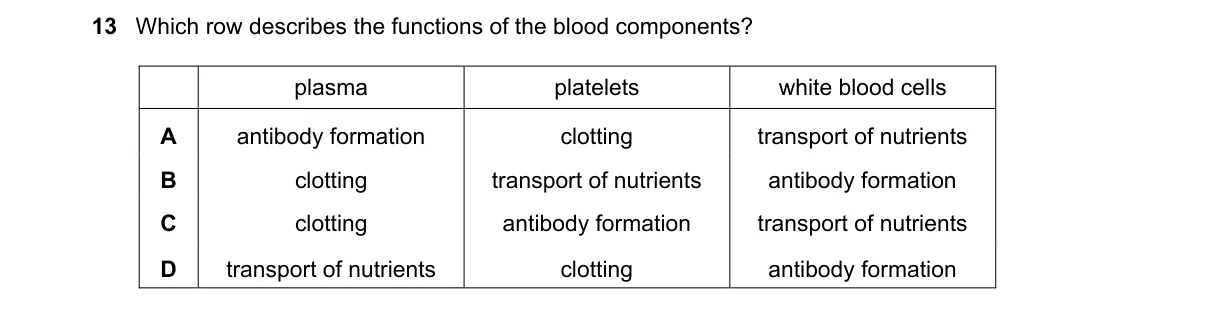
Answer choices
- APlasma: antibody formation, Platelets: clotting, White blood cells: transport of nutrients
- BPlasma: clotting, Platelets: transport of nutrients, White blood cells: antibody formation
- CPlasma: transport of nutrients, Platelets: antibody formation, White blood cells: transport of nutrients
- DPlasma: transport of nutrients, Platelets: clotting, White blood cells: antibody formation
Explanation
Matching Blood Components to Their Functions
Steps:
- Identify plasma as the liquid matrix that transports nutrients, hormones, and waste.
- Recognize platelets as cell fragments essential for blood clotting to prevent bleeding.
- Recall white blood cells (leukocytes) as key players in immune defense, including antibody production.
- Compare options to find the match: plasma for transport, platelets for clotting, white blood cells for antibodies.
Why D is correct:
- Plasma carries nutrients via dissolved proteins and water (basic blood physiology definition); platelets form clots through aggregation (hemostasis process); white blood cells, especially lymphocytes, produce antibodies for immunity (immune response mechanism).
Why the others are wrong:
- A: Plasma does not form antibodies (white blood cells do); white blood cells do not transport nutrients (plasma does).
- B: Plasma does not clot (platelets do); platelets do not transport nutrients (plasma does).
- C: Platelets do not form antibodies (white blood cells do); white blood cells do not transport nutrients (plasma does).
Final answer: D
Topic: Blood
Practice more O Levels/IGCSE Biology (5090) questions on mMCQ.me