O Levels/IGCSE Biology (5090)•5090/11/M/J/21
O Levels/IGCSE Biology (5090) — 5090/11/M/J/21, Question 7
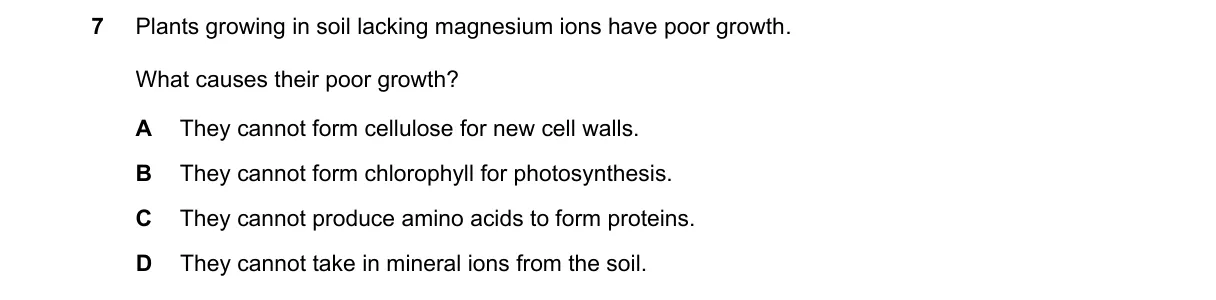
Plants growing in soil lacking magnesium ions have poor growth. What causes their poor growth?
Answer choices
- AThey cannot form cellulose for new cell walls.
- BThey cannot produce amino acids for proteins.
- CThey cannot form chlorophyll for photosynthesis.
- DThey cannot take in mineral ions from the soil.
Explanation
Magnesium's Role in Chlorophyll Synthesis
Steps:
- Identify magnesium's primary function in plants: central atom in chlorophyll molecule.
- Link deficiency to impact: without Mg, chlorophyll cannot form, impairing photosynthesis.
- Connect to growth: reduced photosynthesis limits energy production, causing poor growth.
- Evaluate options: match symptoms to mineral roles, eliminating unrelated deficiencies.
Why C is correct:
- Chlorophyll's structure requires Mg²⁺ ion at its core (porphyrin ring), enabling light absorption for photosynthesis.
Why the others are wrong:
- A: Cellulose synthesis depends on glucose from photosynthesis and carbon, not Mg.
- B: Amino acid production requires nitrogen (e.g., nitrates), not magnesium.
- D: Mg deficiency affects specific uptake but doesn't broadly block all mineral ion absorption.
Final answer: C
Topic: Mineral nutrition
Practice more O Levels/IGCSE Biology (5090) questions on mMCQ.me