O Levels/IGCSE Biology (5090)•5090/11/M/J/21
O Levels/IGCSE Biology (5090) — 5090/11/M/J/21, Question 17
In an investigation, scientists treated plant roots with a chemical that stops aerobic respiration. They observed that after the treatment the plant roots absorbed nitrate ions more slowly. Which statement explains this observation?
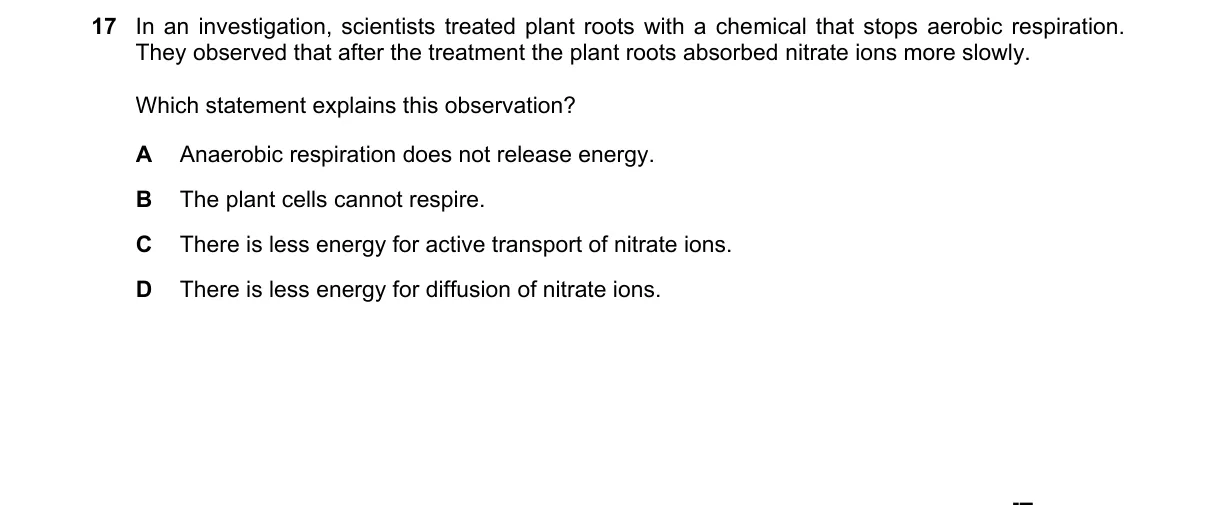
Answer choices
- AAnaerobic respiration does not release energy.
- BThe plant cells cannot respire.
- CThere is less energy for active transport of nitrate ions.
- DThere is less energy for diffusion of nitrate ions.
Explanation
Energy from respiration powers active transport
Steps:
- Aerobic respiration generates ATP, the main energy source for cells.
- The chemical blocks aerobic respiration, reducing ATP production.
- Nitrate ions enter roots via active transport, which requires ATP to move against concentration gradients.
- With less ATP, active transport slows, decreasing nitrate absorption.
Why C is correct:
- Active transport uses ATP from respiration to pump ions like nitrate against gradients, per the definition of active transport in biology.
Why the others are wrong:
- A: Anaerobic respiration releases energy via ATP, though less efficiently than aerobic.
- B: Cells can switch to anaerobic respiration, so they still respire.
- D: Diffusion is passive and requires no energy, so respiration doesn't affect it.
Final answer: C
Topic: Active transport
Practice more O Levels/IGCSE Biology (5090) questions on mMCQ.me