O Levels/IGCSE Biology (5090)•5090/12/M/J/20
O Levels/IGCSE Biology (5090) — 5090/12/M/J/20, Question 11
Water and ions can reach the xylem of a plant root through cell walls, without passing through a cell membrane. How do these substances move through the cell walls?
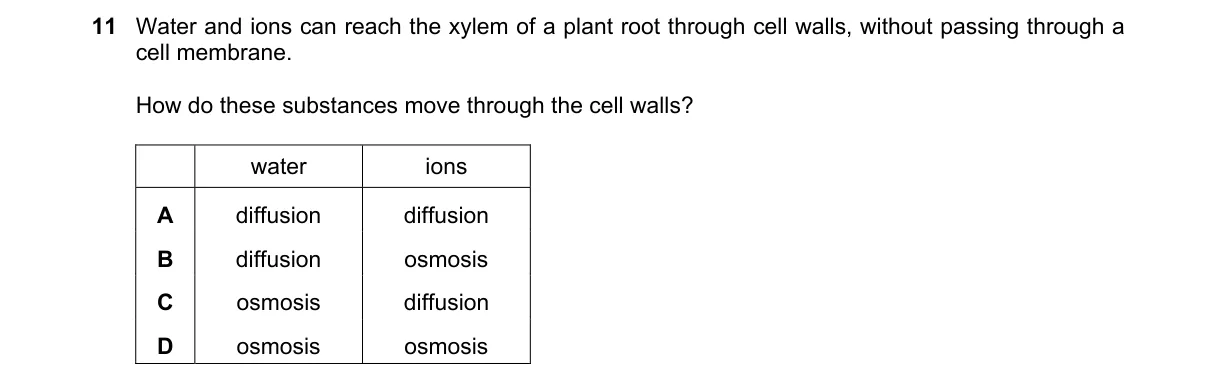
Answer choices
- Awater: diffusion, ions: osmosis
- Bwater: osmosis, ions: diffusion
- Cwater: osmosis, ions: diffusion
- Dwater: osmosis, ions: osmosis
Explanation
Apoplast Pathway Transport Mechanisms
Steps:
- Identify the route: movement through cell walls without crossing membranes describes the apoplast pathway in plant roots.
- Recall definitions: diffusion is passive movement down a concentration gradient; osmosis is water diffusion across a semi-permeable membrane down a water potential gradient.
- Apply to water: in apoplast, no membrane is involved, but water follows osmotic gradients established by root cells, termed osmosis in standard biology contexts.
- Apply to ions: ions move passively down electrochemical gradients through porous cell walls via diffusion.
Why B is correct:
- Osmosis drives water movement toward higher solute concentrations in roots (definition: net water flow across membrane due to solute gradient), while ions diffuse independently through walls.
Why the others are wrong:
- A: Ions do not move by osmosis, as osmosis specifically involves water, not solutes.
- C: Identical to B, likely a duplicate option.
- D: Ions do not move by osmosis; requires membrane and applies only to water.
Final answer: B
Topic: Uptake and transport of water and ions
Practice more O Levels/IGCSE Biology (5090) questions on mMCQ.me