O Levels/IGCSE Biology (5090)•5090/11/M/J/20
O Levels/IGCSE Biology (5090) — 5090/11/M/J/20, Question 3
A student takes a potato and cuts three pieces from it. Each piece is 5 cm x 5 cm x 0.5 cm. He places three pieces in different concentrations of sugar solution. After two hours, he removes the three pieces from the sugar solutions and measures their lengths. The results are shown in the table. Solution length of potato piece X after two hours / cm Y 5.2 4.7 What can be concluded from these results?
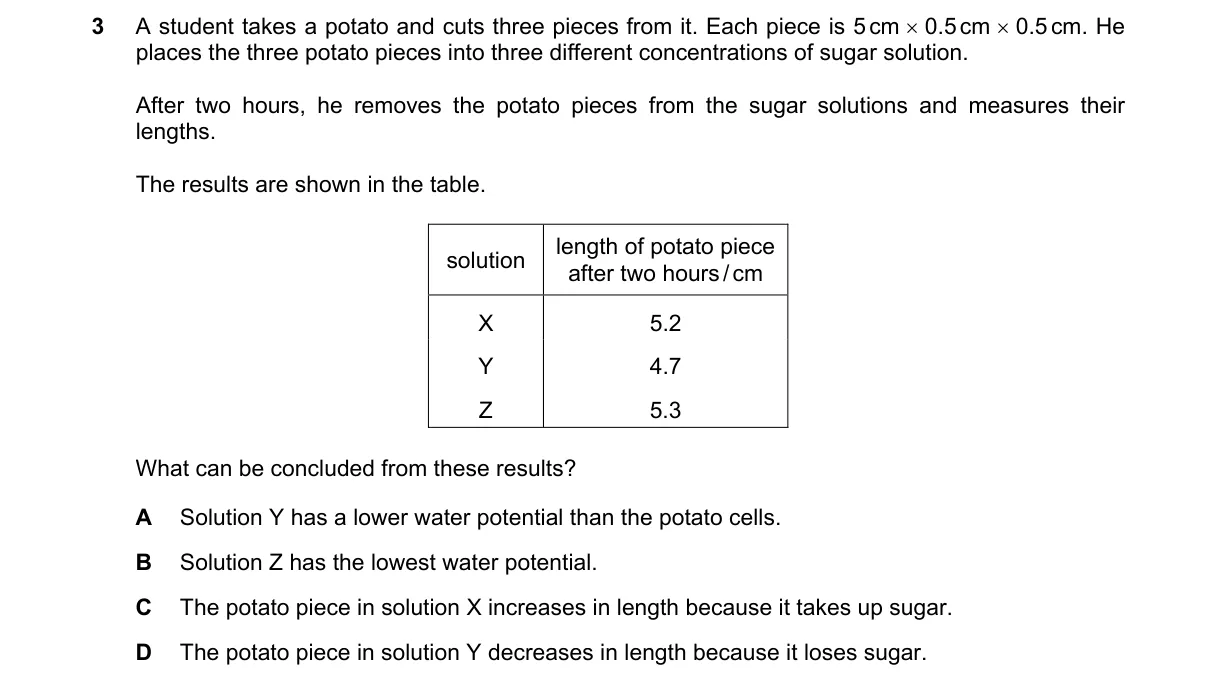
Answer choices
- ASolution Y has a lower water potential than the potato cells.
- BThe potato piece in solution X increases in length because it takes up sugar.
- CThe potato piece in solution Y decreases in length because it loses sugar.
- DOption D
Explanation
Osmosis driven by water potential differences
Steps:
- Potato pieces start at 5 cm length; piece in X grows to 5.2 cm, indicating water uptake via osmosis.
- Piece in Y shrinks to 4.7 cm, indicating water loss via osmosis.
- Growth in X means solution X has higher water potential than potato cells, so water enters potato.
- Shrinkage in Y means solution Y has lower water potential than potato cells, so water exits potato.
Why A is correct:
- Water moves from higher to lower water potential; Y's lower potential causes potato shrinkage as defined by osmosis principles.
Why the others are wrong:
- B: Length increase results from water uptake, not sugar, as potato cells are semi-permeable to water but not solutes.
- C: Length decrease results from water loss, not sugar, as osmosis involves solvent movement.
- D: Not enough information (option incomplete).
Final answer: A
Topic: Diffusion and osmosis
Practice more O Levels/IGCSE Biology (5090) questions on mMCQ.me