O Levels/IGCSE Biology (5090)•5090/12/M/J/19
O Levels/IGCSE Biology (5090) — 5090/12/M/J/19, Question 16
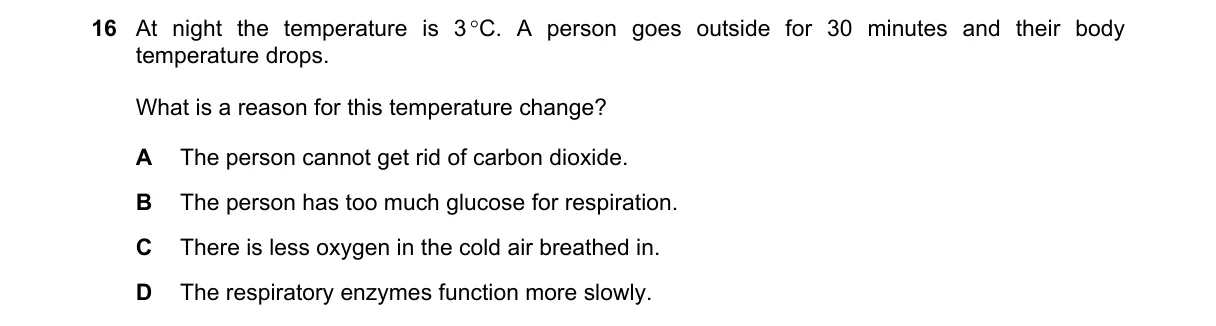
At night the temperature is 3°C. A person goes outside for 30 minutes and their body temperature drops. What is the reason for this temperature change?
Answer choices
- AThe person cannot get rid of carbon dioxide.
- BThe person has too much glucose for respiration.
- CThere is less oxygen in the cold air breathed in.
- DThe respiratory enzymes function more slowly.
Explanation
Cold slows respiratory enzyme activity, reducing body heat production
Steps:
- Exposure to 3°C air causes rapid heat loss from the body to the environment.
- To compensate, metabolic rate should increase, but cold inhibits this process.
- Respiration, a key heat-generating metabolic pathway, relies on enzymes.
- Lower temperatures reduce enzyme efficiency, slowing respiration and heat output, leading to body temperature drop.
Why D is correct:
- Enzymes in respiration have an optimal temperature around 37°C; below this, reaction rates slow per the Q10 temperature coefficient, where activity roughly halves for every 10°C drop, reducing ATP and heat production.
Why the others are wrong:
- A: Carbon dioxide removal occurs via diffusion in lungs, unaffected by external cold.
- B: Glucose availability does not limit respiration in this scenario; cold directly impacts enzyme kinetics.
- C: Cold air has the same oxygen percentage (21%) as warm air, just higher density, so oxygen intake remains adequate.
Final answer: D
Topic: Temperature control
Practice more O Levels/IGCSE Biology (5090) questions on mMCQ.me