O Levels/IGCSE Biology (5090)•5090/11/M/J/19
O Levels/IGCSE Biology (5090) — 5090/11/M/J/19, Question 20
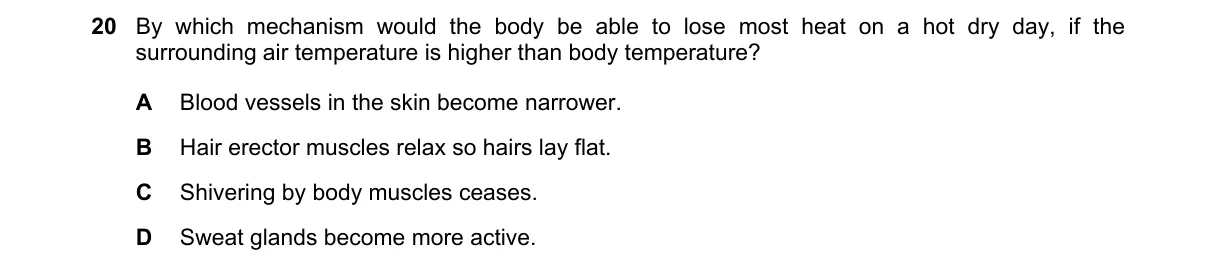
By which mechanism would the body be able to lose most heat on a hot day, if surrounding air temperature is higher than body temperature?
Answer choices
- ABlood vessels in the skin become narrower.
- BHair erector muscles relax so hairs lie flat.
- CShivering by body muscles ceases.
- DSweat glands become more active.
Explanation
Evaporation via sweating as primary heat loss on hot days
Steps:
- Identify scenario: Air temperature exceeds body temperature, limiting conduction, convection, and radiation for heat loss.
- Recall thermoregulation: Body relies on evaporation when environmental heat prevents passive transfer.
- Evaluate options: Focus on mechanisms promoting active heat dissipation rather than conservation or production.
- Select best: Increased sweat production enables evaporative cooling, the most effective method here.
Why D is correct:
- Evaporation of sweat absorbs heat via the latent heat of vaporization (about 2420 J/g), directly cooling the skin and blood.
Why the others are wrong:
- A: Narrower vessels (vasoconstriction) reduce skin blood flow, conserving heat by limiting dissipation.
- B: Flat hairs reduce insulation minimally in humans and do not actively remove heat.
- C: Ceasing shivering stops heat generation but does not facilitate heat loss.
Final answer: D
Topic: Temperature control
Practice more O Levels/IGCSE Biology (5090) questions on mMCQ.me