O Levels/IGCSE Biology (5090)•5090/12/M/J/18
O Levels/IGCSE Biology (5090) — 5090/12/M/J/18, Question 38
The table shows variation in foot length in a number of students. Foot length (cm) Number of students 20.0-20.9 5 22.0-22.9 15 24.0-24.9 17 26.0-26.9 0 Which row identifies this type of variation and states cause?
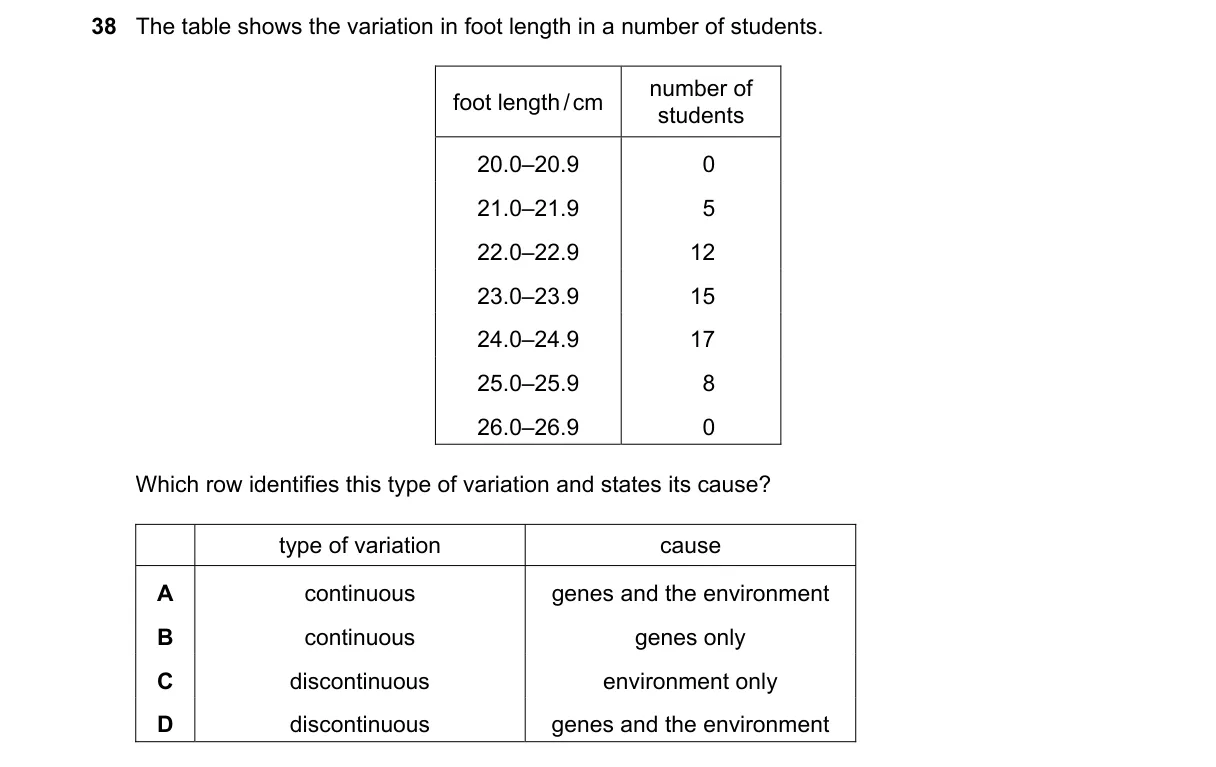
Answer choices
- Acontinuous genes and the environment
- Bcontinuous environment only
- Cdiscontinuous genes only
- Ddiscontinuous genes and the environment
Explanation
Continuous variation from polygenic and environmental influences
Steps:
- Observe the data: foot lengths form a range (20-26.9 cm) with varying frequencies, showing a bell-like distribution despite gaps.
- Identify variation type: measurements in decimals indicate continuous trait, not discrete categories.
- Recall causes: continuous traits like height or foot length result from multiple genes (polygenic) plus environmental factors like nutrition.
- Match to options: polygenic inheritance plus environment fits continuous variation.
Why A is correct:
- Continuous variation is defined as polygenic (multiple genes) combined with environmental effects, producing a smooth range of phenotypes as in foot length data.
Why the others are wrong:
- B: Ignores genetic role; environment alone cannot explain heritable continuous traits.
- C: Discontinuous variation involves single genes with distinct categories, not a ranged distribution.
- D: Discontinuous applies to discrete traits like blood groups, not this measurable continuum.
Final answer: A
Topic: Variation
Practice more O Levels/IGCSE Biology (5090) questions on mMCQ.me