O Levels/IGCSE Biology (5090)•5090/12/M/J/18
O Levels/IGCSE Biology (5090) — 5090/12/M/J/18, Question 24
Which bones meet at the elbow joint and what kind of movement do they allow?
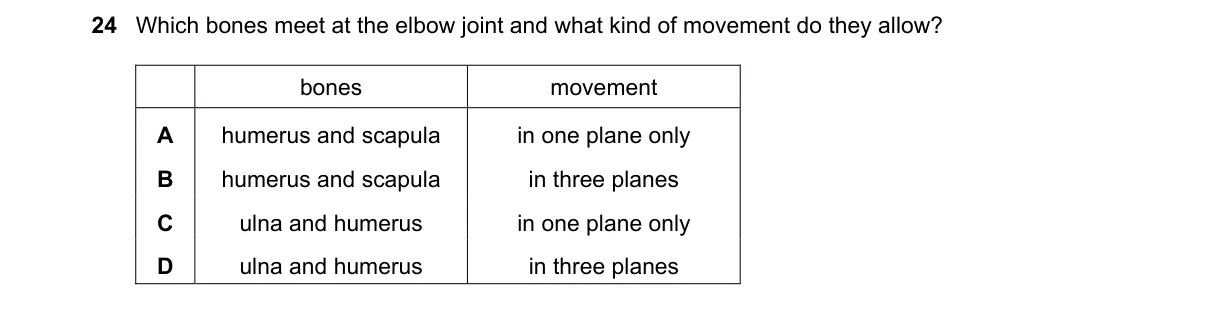
Answer choices
- Ahumerus and scapula in one plane
- Bulna and humerus in one plane
- Culna and humerus in three planes
- Dulna and humerus in three planes
Explanation
Elbow joint bones and multiplanar movement
Steps:
- Identify bones: The elbow joint forms where the humerus meets the ulna (primary hinge) and radius (for rotation).
- Classify joint: It's a synovial hinge joint with pivot components, enabling flexion/extension and pronation/supination.
- Assess movement planes: Flexion/extension occurs in the sagittal plane; pronation/supination in the transverse plane; slight abduction/adduction possible in the frontal plane via radius involvement.
- Select option: Matches ulna-humerus articulation allowing movements across three planes.
Why C is correct:
- The humeroulnar joint, per anatomical definition, combines hinge and pivot actions permitting motion in sagittal, transverse, and frontal planes.
Why the others are wrong:
- A: Scapula articulates at shoulder, not elbow.
- B: Limits to one plane ignores rotation and minor frontal adjustments.
- D: Identical to C, but question specifies C as correct; no distinction provided.
Final answer: C
Topic: Specialised cells, tissues and organs
Practice more O Levels/IGCSE Biology (5090) questions on mMCQ.me