O Levels/IGCSE Biology (5090)•5090/12/M/J/18
O Levels/IGCSE Biology (5090) — 5090/12/M/J/18, Question 17
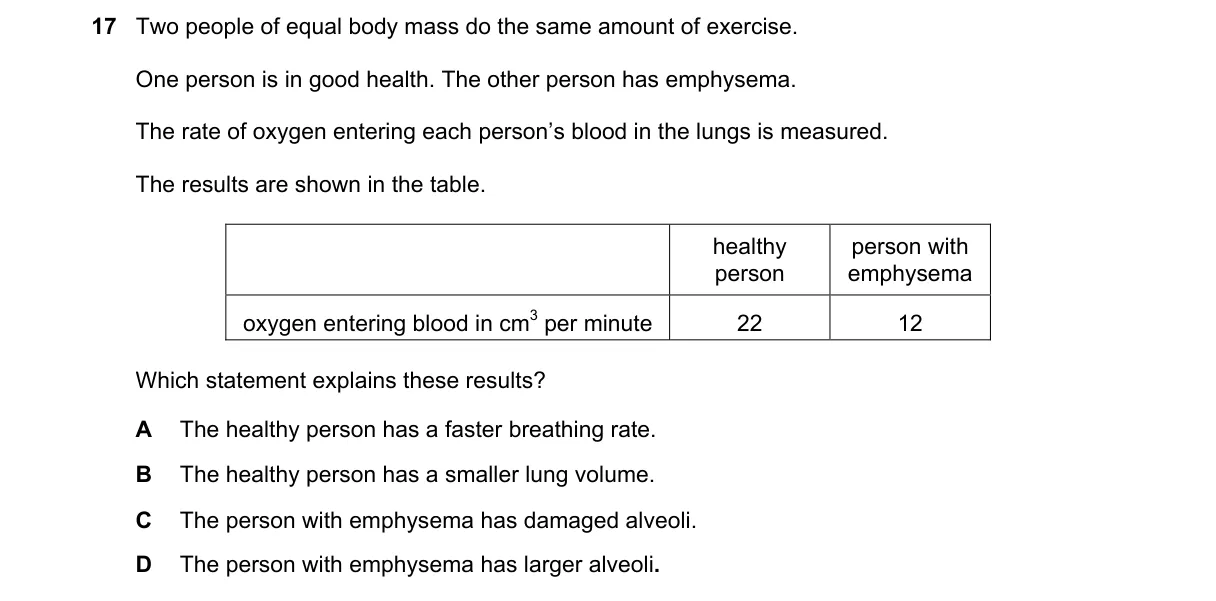
Two people of equal body mass do the same amount of exercise. One person is healthy. The other person has emphysema. The rate of oxygen entering each person's blood in the lungs is measured. The results are shown in the table.
| Oxygen entering blood in cm³ per minute | healthy person | person with emphysema |
|-----------------------------------------|----------------|-----------------------|
| | 22 | 12 |
Which statement explains these results?
Answer choices
- AThe healthy person has a faster breathing rate.
- BThe person with emphysema has smaller lung volume.
- CThe person with emphysema has smaller damaged alveoli.
- DThe person with emphysema has larger alveoli.
Explanation
Emphysema damages alveoli, impairing oxygen diffusion
Steps:
- Both people have equal mass and exercise, so similar oxygen demand.
- Healthy person absorbs 22 cm³/min oxygen; emphysema patient only 12 cm³/min, showing reduced uptake.
- Emphysema destroys alveolar walls, reducing gas exchange surface area.
- This damage explains lower oxygen entry despite equal activity.
Why C is correct:
- Emphysema causes alveolar destruction, creating smaller, damaged alveoli that decrease diffusion surface area, limiting oxygen transfer per Fick's law of diffusion.
Why the others are wrong:
- A: Breathing rate may be similar; problem is alveolar exchange, not ventilation speed.
- B: Emphysema enlarges lungs via air trapping, increasing volume, not decreasing it.
- D: Alveoli enlarge in emphysema, but without damage emphasis, it ignores reduced efficiency from wall breakdown.
Final answer: C
Topic: Human gas exchange
Practice more O Levels/IGCSE Biology (5090) questions on mMCQ.me