O Levels/IGCSE Biology (5090)•5090/11/M/J/18
O Levels/IGCSE Biology (5090) — 5090/11/M/J/18, Question 19
The diagram shows how a kidney dialysis machine works. Each shape represents a molecule found in blood or dialysis fluid. Which shape represents urea?
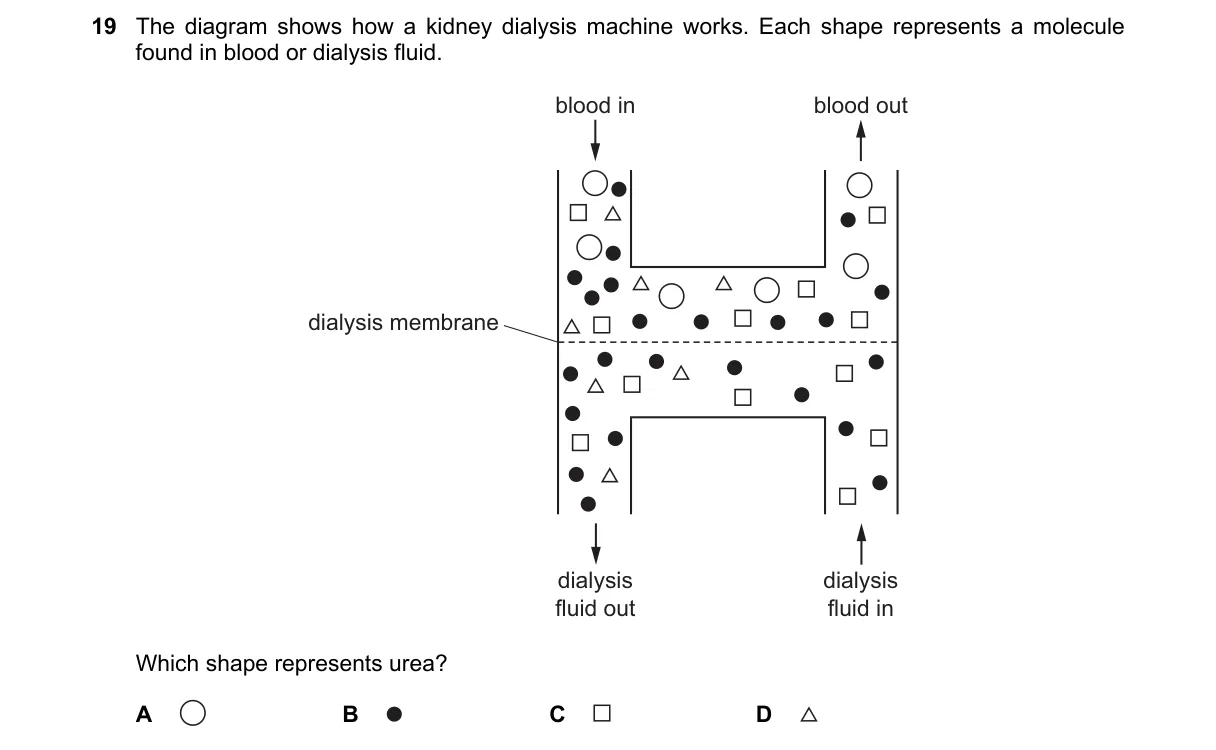
Answer choices
- A○
- B●
- C□
- D△
Explanation
Urea diffusion in kidney dialysis
Steps:
- Identify the semi-permeable membrane separating blood from dialysis fluid, allowing small waste molecules like urea to pass.
- Note that blood contains high urea concentration, while dialysis fluid has none, driving diffusion from blood to fluid.
- Observe shapes: triangles (△) appear only in blood initially and move to dialysis fluid, indicating small diffusible wastes.
- Confirm other shapes either stay in blood (large molecules) or are absent in blood (fluid components).
Why D is correct:
- Urea is a small waste molecule that diffuses across the membrane per Fick's law of diffusion, matching the triangle's movement pattern.
Why the others are wrong:
- A (○): Represents glucose, present in both sides without net movement.
- B (●): Represents proteins, too large to cross the membrane.
- C (□): Represents salts, balanced in dialysis fluid to prevent diffusion.
Final answer: D
Topic: Urinary system
Practice more O Levels/IGCSE Biology (5090) questions on mMCQ.me