O Levels/IGCSE Chemistry (5070)•5070/12/O/N/24
O Levels/IGCSE Chemistry (5070) — 5070/12/O/N/24, Question 39
Three liquids, X, Y and Z are tested and the results are shown. add anhydrous copper(II) chloride: X blue to pink, Y no change, Z blue to pink. boiling point: X 100°C, Y 98°C, Z 103°C. What may be deduced about X, Y and Z from this information?
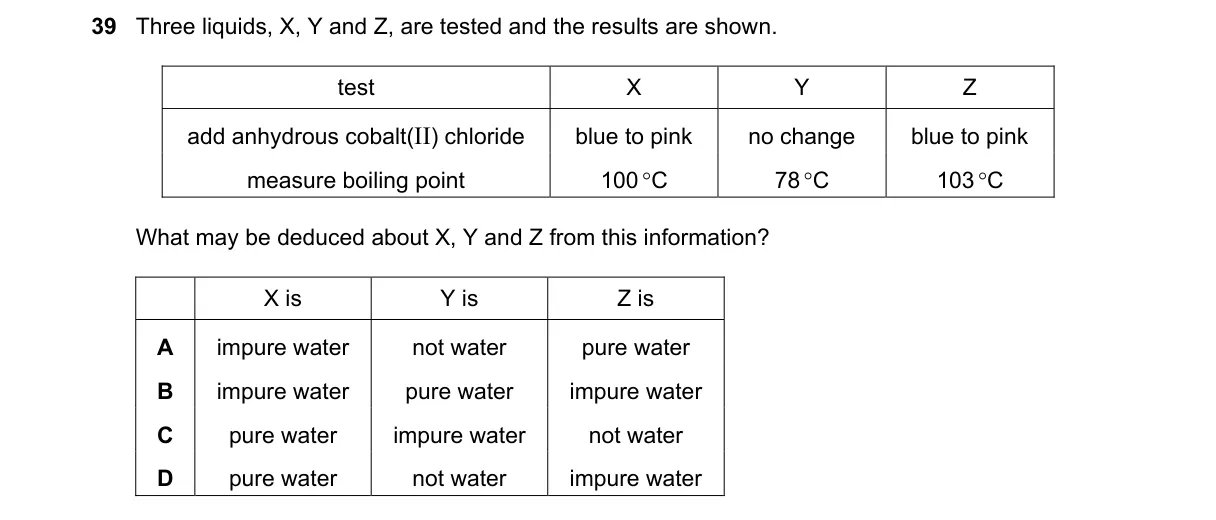
Answer choices
- AX is impure water, Y is pure water, Z is impure water
- BX is pure water, Y is impure water, Z is pure water
- CX is pure water, Y is not water, Z is impure water
- DX is impure water, Y is not water, Z is pure water
Explanation
Water detection and boiling point elevation Steps:
- Anhydrous copper(II) chloride (likely intended as cobalt chloride test) turns blue to pink in presence of water due to hydration.
- X and Z show color change, indicating they contain water; Y shows no change, so Y lacks water.
- Pure water boils at 100°C; non-volatile impurities raise boiling point via colligative properties (ΔT_b = K_b × m).
- X boils at 100°C (pure water), Y at 98°C (not water, lower boiling suggests different liquid), Z at 103°C (impure water, elevated boiling point).
Why C is correct:
- Matches test results (X/Z contain water, Y does not) and boiling points (100°C for pure, >100°C for impure per boiling point elevation formula).
Why the others are wrong:
- A: Y no color change, cannot be pure water.
- B: Y no color change and 98°C boiling, not impure water.
- D: Z boils at 103°C, indicating impurity, not pure water.
Final answer: C
Topic: Water
Practice more O Levels/IGCSE Chemistry (5070) questions on mMCQ.me