O Levels/IGCSE Chemistry (5070)•5070/12/O/N/24
O Levels/IGCSE Chemistry (5070) — 5070/12/O/N/24, Question 27
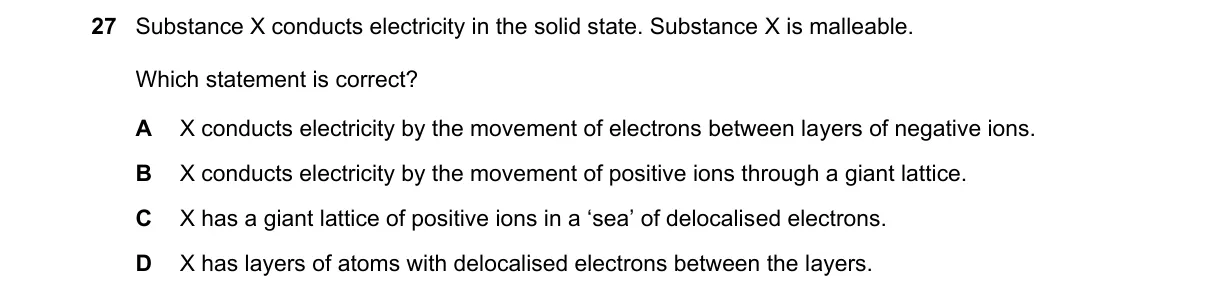
Substance X conducts electricity in the solid state. Substance X is malleable. Which statement explains why X conducts electricity in the solid state?
Answer choices
- AX conducts electricity by the movement of electrons between layers of negative ions.
- BX has a giant lattice of positive ions in a sea of delocalised electrons.
- CX has layers of atoms with delocalised electrons between the layers.
- DX has layers of atoms with localised electrons between layers.
Explanation
Layered structure with delocalized electrons
Steps:
- Identify malleability: indicates weak forces between layers, allowing sliding without breaking.
- Note solid-state conductivity: requires mobile charge carriers like delocalized electrons.
- Match properties: layered atomic structure with delocalized electrons fits both traits.
- Eliminate options: discard those implying ionic, metallic, or localized electrons.
Why C is correct:
- Delocalized electrons between atomic layers provide mobile charge carriers for conductivity in solids, as defined in band theory for materials like graphite.
Why the others are wrong:
- A: Describes ionic compounds, which do not conduct in solid state due to fixed ions.
- B: Describes metallic bonding with a 3D lattice, which is ductile but not distinctly layered and malleable via sliding.
- D: Localized electrons prevent charge mobility, blocking solid-state conduction.
Final answer: C
Topic: Metallic bonding
Practice more O Levels/IGCSE Chemistry (5070) questions on mMCQ.me