O Levels/IGCSE Chemistry (5070)•5070/12/O/N/24
O Levels/IGCSE Chemistry (5070) — 5070/12/O/N/24, Question 24
The table shows four methods used to prepare pure salts. Which row shows a method of making a pure sample of each named salt?
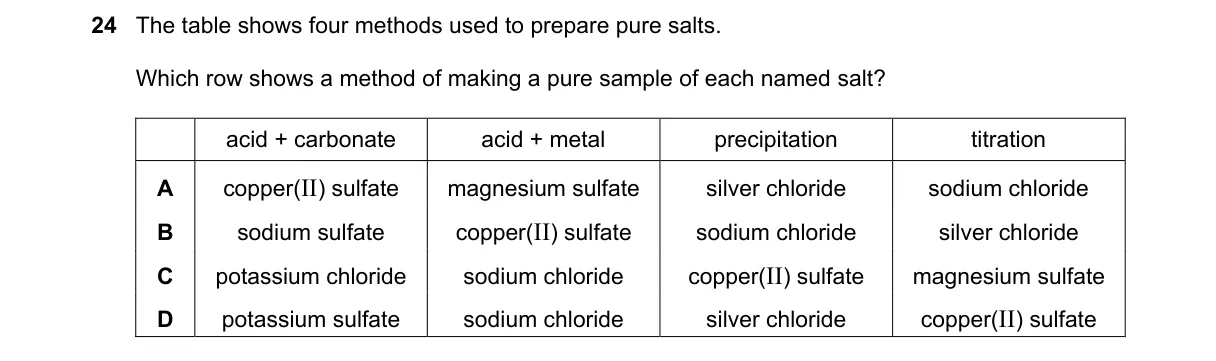
Answer choices
- Acopper(II) sulfate, magnesium sulfate, silver chloride, sodium chloride
- Bsodium sulfate, copper(II) sulfate, silver chloride, silver chloride
- Cpotassium chloride, sodium chloride, copper(II) sulfate, magnesium sulfate
- Dpotassium sulfate, sodium chloride, silver chloride, copper(II) sulfate
Explanation
Matching salts to pure preparation methods Steps:
- Recall standard methods: soluble salts like sulfates and chlorides via acid-base reactions followed by crystallization; insoluble salts like silver chloride via precipitation and filtration.
- Check option A: copper(II) sulfate (CuO + H₂SO₄, crystallize), magnesium sulfate (Mg + H₂SO₄, crystallize), silver chloride (AgNO₃ + NaCl, precipitate), sodium chloride (NaOH + HCl titration, crystallize)—all yield pure samples.
- Eliminate B, C, D for mismatches or duplicates.
- Confirm A aligns with one method per salt for purity.
Why A is correct:
- Each salt uses a method ensuring purity: precipitation isolates insolubles (AgCl), while neutralization/crystallization purifies solubles (CuSO₄, MgSO₄, NaCl) per solubility rules.
Why the others are wrong:
- B: Lists silver chloride twice, duplicating an insoluble precipitation method.
- C: Includes only soluble salts, misassigning an insoluble precipitation method.
- D: Potassium sulfate mismatches a method suited for insolubles like silver chloride.
Final answer: A
Topic: Preparation of salts
Practice more O Levels/IGCSE Chemistry (5070) questions on mMCQ.me