O Levels/IGCSE Chemistry (5070)•5070/12/O/N/24
O Levels/IGCSE Chemistry (5070) — 5070/12/O/N/24, Question 23
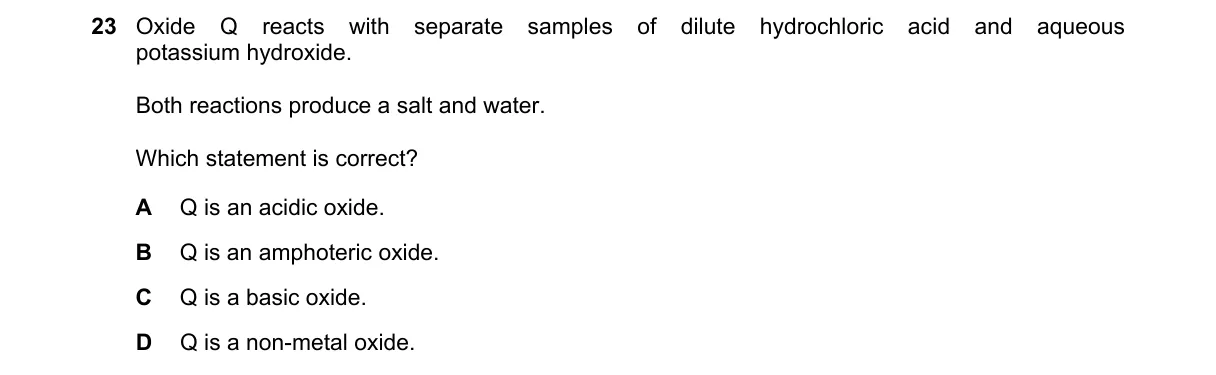
Oxide Q reacts with separate samples of dilute hydrochloric acid and aqueous potassium hydroxide. Both reactions produce a salt and water. Which statement is correct?
Answer choices
- AQ is an acidic oxide.
- BQ is an amphoteric oxide.
- CQ is a basic oxide.
- DQ is a non-metal oxide.
Explanation
Oxide Q reacts with both acid and base, indicating amphoteric nature
Steps:
- Acidic oxides react only with bases to form salt and water.
- Basic oxides react only with acids to form salt and water.
- Amphoteric oxides react with both acids and bases to form salt and water.
- Oxide Q reacts with HCl (acid) and KOH (base), producing salt and water in both, matching amphoteric behavior.
Why B is correct:
- Amphoteric oxides, like Al2O3, react with acids (e.g., Al2O3 + 6HCl → 2AlCl3 + 3H2O) and bases (e.g., Al2O3 + 2KOH + 3H2O → 2KAl(OH)4), forming salts and water.
Why the others are wrong:
- A: Acidic oxides, like CO2, do not react with acids like HCl.
- C: Basic oxides, like MgO, do not react with bases like KOH.
- D: Non-metal oxides are typically acidic and do not react with acids.
Final answer: B
Topic: Oxides
Practice more O Levels/IGCSE Chemistry (5070) questions on mMCQ.me