O Levels/IGCSE Chemistry (5070)•5070/12/O/N/24
O Levels/IGCSE Chemistry (5070) — 5070/12/O/N/24, Question 18
Samples of nitrogen and hydrogen are reacted and allowed to reach equilibrium. The equation is N₂ + 3H₂ ⇌ 2NH₃ ΔH=-92 kJ/mol. The temperature is increased. Which statement about the new equilibrium is correct?
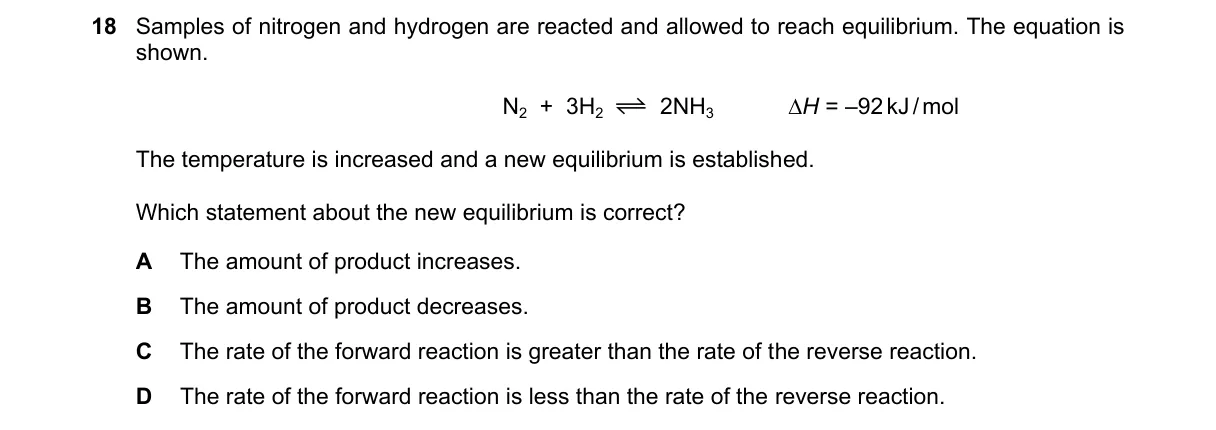
Answer choices
- AThe amount of product increases.
- BThe rate of forward reaction is greater than the rate of reverse reaction.
- CThe rate of forward reaction is less than the rate of reverse reaction.
- DThe amount of product decreases.
Explanation
Le Chatelier's Principle: Temperature Effect on Exothermic Reaction
Steps:
- Identify the reaction as exothermic (ΔH = -92 kJ/mol), treating heat as a product.
- Increasing temperature adds heat, shifting equilibrium left toward reactants to absorb heat.
- This decreases NH₃ yield while increasing N₂ and H₂.
- At the new equilibrium, forward and reverse rates equalize again.
Why D is correct:
- Le Chatelier's principle predicts shift opposing stress; for exothermic forward reaction, higher temperature favors endothermic reverse, reducing product.
Why the others are wrong:
- A: Shift left decreases product, not increases.
- B: At any equilibrium, forward rate equals reverse rate by definition.
- C: Rates are equal at equilibrium, neither greater nor less.
Final answer: D
Topic: Reversible reactions and equilibrium
Practice more O Levels/IGCSE Chemistry (5070) questions on mMCQ.me