O Levels/IGCSE Chemistry (5070)•5070/12/O/N/24
O Levels/IGCSE Chemistry (5070) — 5070/12/O/N/24, Question 14
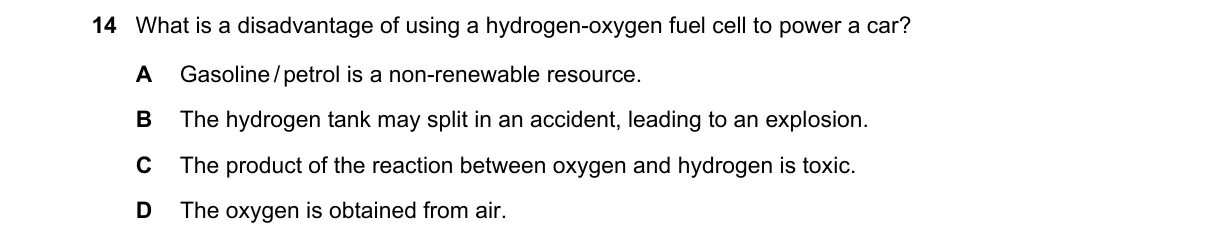
What is a disadvantage of using a hydrogen-oxygen fuel cell to power a car?
Answer choices
- AGasoline/petrol is a non-renewable resource.
- BThe hydrogen tank may split in an accident, leading to an explosion.
- CThe product of the reaction between oxygen and hydrogen is toxic.
- DThe oxygen is obtained from air.
Explanation
Safety Hazard of Hydrogen Storage
Steps:
- Recall that hydrogen-oxygen fuel cells produce electricity via H₂ + ½O₂ → H₂O, powering the car cleanly.
- Identify potential disadvantages: hydrogen's high flammability and storage challenges in high-pressure tanks.
- Evaluate options: A relates to fossil fuels, not hydrogen; C misstates the water byproduct; D is neutral as air-sourced oxygen is abundant.
- Select B as it highlights the explosion risk from tank rupture in crashes.
Why B is correct:
- Hydrogen is stored compressed at high pressures; rupture in an accident releases flammable gas that ignites easily, causing explosions (per flammability limits: 4-75% in air).
Why the others are wrong:
- A: Applies to gasoline vehicles, irrelevant to renewable hydrogen fuel cells.
- C: Reaction product is water (H₂O), which is non-toxic.
- D: Sourcing oxygen from air is efficient and cost-free, not a disadvantage.
Final answer: B
Topic: Hydrogen–oxygen fuel cells
Practice more O Levels/IGCSE Chemistry (5070) questions on mMCQ.me