O Levels/IGCSE Chemistry (5070)•5070/11/O/N/24
O Levels/IGCSE Chemistry (5070) — 5070/11/O/N/24, Question 33
Alkenes undergo addition reactions with bromine to form dibromoalkanes. Which statement is correct?
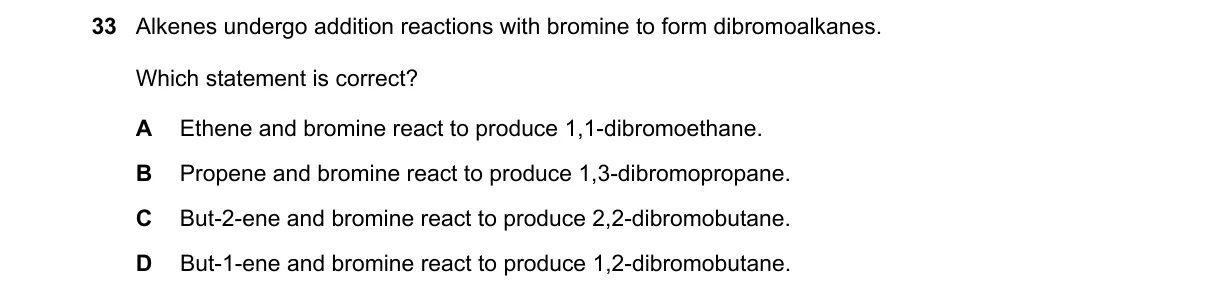
Answer choices
- AEthene and bromine react to produce 1,1-dibromoethane.
- BPropene and bromine react to produce 1,3-dibromopropane.
- CBut-2-ene and bromine react to produce 2,3-dibromobutane.
- DBut-1-ene and bromine react to produce 1,2-dibromobutane.
Explanation
Vicinal dibromide formation via electrophilic addition
Steps:
- Identify the position of the C=C double bond in the alkene.
- Br2 adds across the double bond, with one Br attaching to each sp2 carbon.
- The Br atoms end up on adjacent carbons (vicinal positions).
- Name the product using the original chain numbering for the lowest Br positions.
Why D is correct:
- But-1-ene (CH2=CHCH2CH3) has the double bond between C1 and C2; addition gives BrCH2CHBrCH2CH3, or 1,2-dibromobutane, per the mechanism of electrophilic addition.
Why the others are wrong:
- A: Ethene (CH2=CH2) adds Br to each carbon, yielding 1,2-dibromoethane (vicinal), not 1,1-dibromoethane (geminal, impossible for this reaction).
- B: Propene (CH3CH=CH2) adds Br to C1 and C2, yielding 1,2-dibromopropane, not 1,3-dibromopropane (non-adjacent Br).
- C: But-2-ene (CH3CH=CHCH3) adds Br to C2 and C3, but produces stereoisomers of 2,3-dibromobutane (meso and racemic), not a single compound as stated.
Final answer: D
Topic: Alkenes
Practice more O Levels/IGCSE Chemistry (5070) questions on mMCQ.me