O Levels/IGCSE Chemistry (5070)•5070/11/O/N/24
O Levels/IGCSE Chemistry (5070) — 5070/11/O/N/24, Question 22
When copper(II) sulfate crystals, CuSO4·5H2O, react as shown. CuSO4·5H2O(s) → CuSO4(s) + 5H2O(g). When [1.], copper(II) sulfate [2.], which is [3.], in appearance, is heated, it [4.]. Which words correctly complete gaps 1, 2, 3 and 4?
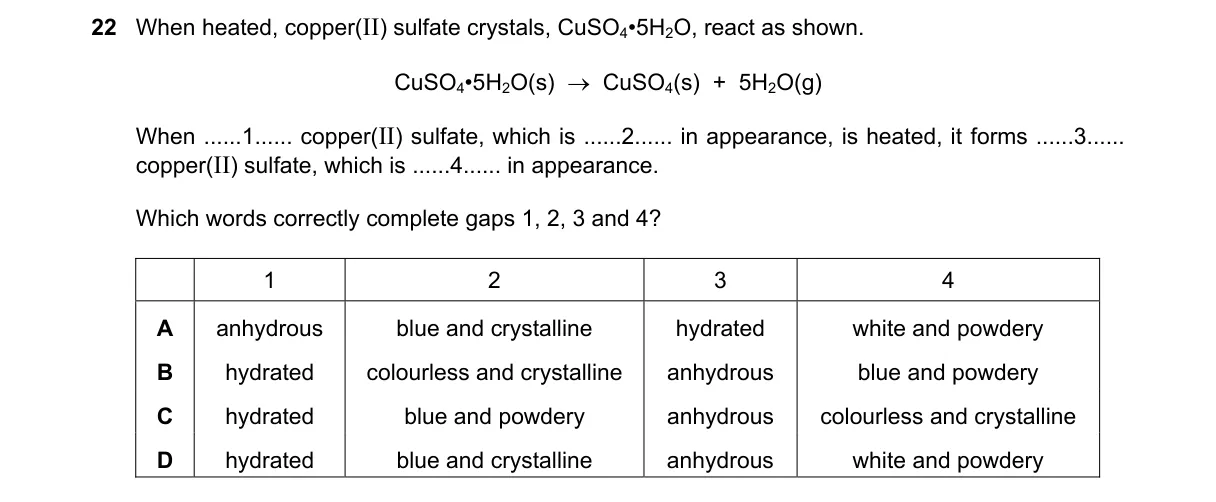
Answer choices
- A1. anhydrous, 2. blue crystalline, 3. white, 4. powder
- B1. anhydrous, 2. colourless crystalline, 3. anhydrous, 4. blue powder
- C1. hydrated, 2. blue powder, 3. anhydrous, 4. colourless crystalline
- D1. hydrated, 2. blue crystalline, 3. anhydrous, 4. white powder
Explanation
Dehydration of hydrated copper(II) sulfate
Steps:
- Identify the reactant as CuSO₄·5H₂O, the hydrated form, filling gap 1 with "hydrated."
- Note the hydrated form appears as blue crystals, filling gap 2 with "blue crystalline."
- Recognize the product CuSO₄ as the anhydrous form, filling gap 3 with "anhydrous."
- Observe the anhydrous product as a white powder, filling gap 4 with "white powder."
Why D is correct:
- The formula CuSO₄·5H₂O defines the blue hydrated crystals dehydrating to white anhydrous CuSO₄ powder upon heating, matching the reaction equation.
Why the others are wrong:
- A: Incorrectly starts with "anhydrous" instead of hydrated reactant.
- B: Misstates starting material as colourless and anhydrous, reversing colors.
- C: Describes hydrated form as blue powder (it's crystalline) and product as colourless crystalline (it's white powder).
Final answer: D
Topic: Preparation of salts
Practice more O Levels/IGCSE Chemistry (5070) questions on mMCQ.me