O Levels/IGCSE Chemistry (5070)•5070/11/O/N/24
O Levels/IGCSE Chemistry (5070) — 5070/11/O/N/24, Question 15
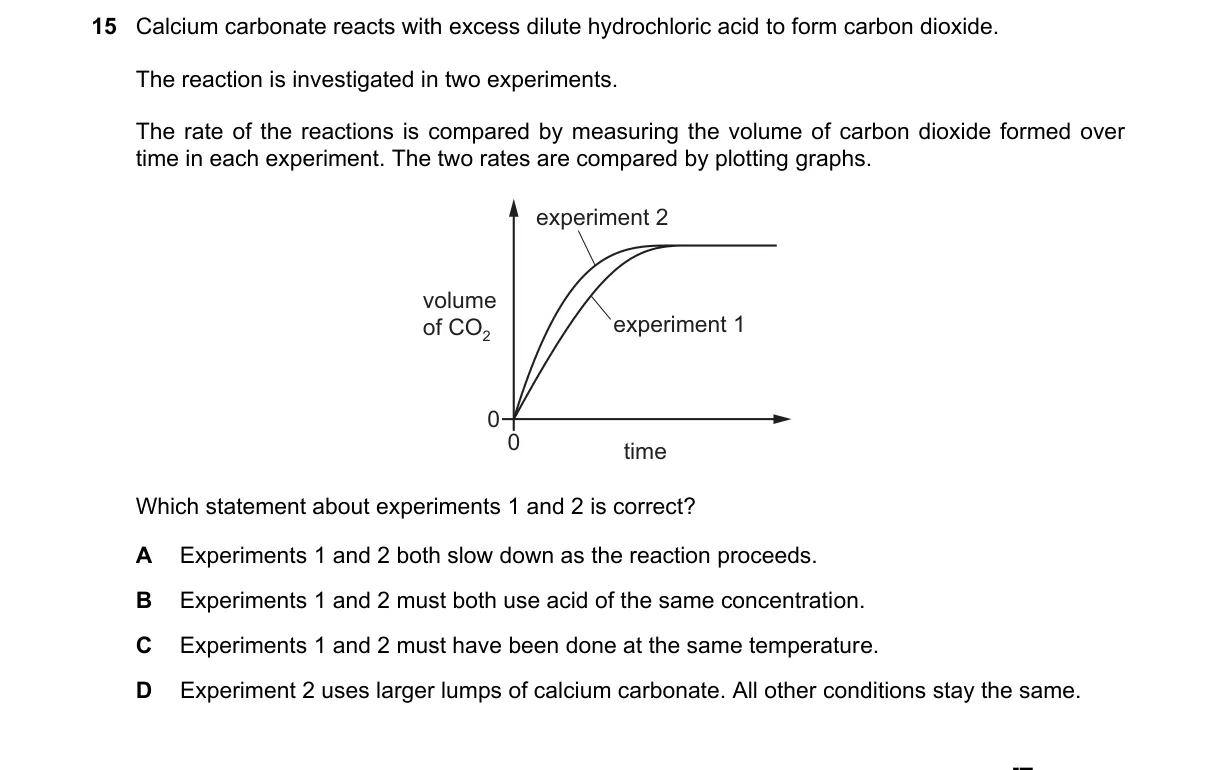
Calcium carbonate reacts with excess dilute hydrochloric acid to form carbon dioxide. The reaction is investigated in two experiments. The rate of the reactions is compared by measuring the volume of carbon dioxide formed over time in each experiment. The rates are compared by plotting graphs. volume of CO₂ experiment 2 experiment 1 0 time Which statement about experiments 1 and 2 is correct?
Answer choices
- AExperiments 1 and 2 must both use the same concentration of the reaction process.
- BExperiments 1 and 2 must both be of the same temperature.
- CExperiments 1 and 2 must have been done at the same temperature.
- DExperiment 2 uses larger lumps of calcium carbonate. All other conditions stay the same.
Explanation
Conditions for comparing reaction rates via gas volume graphs
Steps:
- The graph shows experiment 2 produces more CO₂ at each time, indicating a faster rate.
- Rate comparison relies on volume change over time, requiring identical total possible CO₂ volume.
- Total CO₂ depends on CaCO₃ amount with excess HCl, so same CaCO₃ mass is needed.
- Acid concentration affects rate but not total volume (excess), so same [HCl] isolates other variables like particle size.
Why A is correct:
- Rate law for the reaction (rate = k [HCl]^1 [CaCO₃ surface]) requires same [HCl] to attribute volume differences to rate changes, not concentration variations.
Why the others are wrong:
- B: Incomplete phrasing; temperature likely same but not specified as "must both be of" it—focus is concentrations for volume-based rates.
- C: Temperature could vary to cause rate difference; not required to be identical for graph comparison.
- D: Larger lumps reduce surface area, slowing rate (shallower curve), but experiment 2 is faster, contradicting this.
Final answer: A
Topic: Rate of reaction
Practice more O Levels/IGCSE Chemistry (5070) questions on mMCQ.me