O Levels/IGCSE Chemistry (5070)•5070/12/O/N/23
O Levels/IGCSE Chemistry (5070) — 5070/12/O/N/23, Question 6
When dilute hydrochloric acid is added to aqueous lead(II) nitrate, a white precipitate of lead(II) chloride is formed. What is the ionic equation for this reaction?
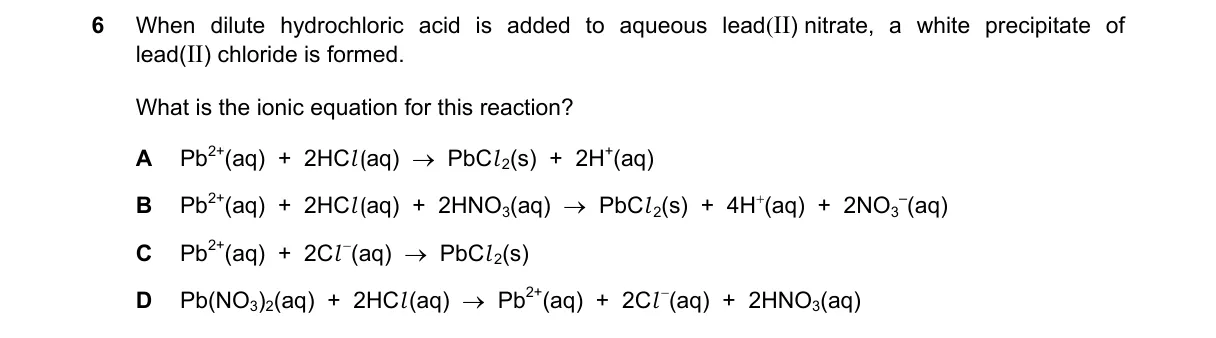
Answer choices
- APb²⁺(aq) + 2HCl(aq) → PbCl₂(s) + 2H⁺(aq)
- BPb²⁺(aq) + 2Cl⁻(aq) → PbCl₂(s)
- CPb(NO₃)₂(aq) + 2HCl(aq) → PbCl₂(s) + 2HNO₃(aq)
- DPb²⁺(aq) + 2NO₃⁻(aq) + 2H⁺(aq) + 2Cl⁻(aq) → PbCl₂(s) + 2H⁺(aq) + 2NO₃⁻(aq)
Explanation
Net ionic equation for precipitation Steps:
- Write molecular equation: Pb(NO₃)₂(aq) + 2HCl(aq) → PbCl₂(s) + 2HNO₃(aq).
- Dissociate into ions: Pb²⁺(aq) + 2NO₃⁻(aq) + 2H⁺(aq) + 2Cl⁻(aq) → PbCl₂(s) + 2H⁺(aq) + 2NO₃⁻(aq).
- Identify spectators: NO₃⁻ and H⁺ unchanged on both sides.
- Cancel spectators for net ionic: Pb²⁺(aq) + 2Cl⁻(aq) → PbCl₂(s).
Why B is correct:
- Net ionic equations show only reacting species, excluding spectators, per standard chemistry definition.
Why the others are wrong:
- A: Mixes ions and molecules; HCl should be 2Cl⁻(aq), and H⁺ is spectator.
- C: Full molecular equation, includes undissociated compounds.
- D: Total ionic equation, fails to cancel spectator ions.
Final answer: B
Topic: Preparation of salts
Practice more O Levels/IGCSE Chemistry (5070) questions on mMCQ.me