O Levels/IGCSE Chemistry (5070)•5070/12/O/N/23
O Levels/IGCSE Chemistry (5070) — 5070/12/O/N/23, Question 34
In the fractional distillation of petroleum, different fractions are obtained at the top and bottom of the fractionating column. Which properties does the fraction obtained at the top of the fractionating column have compared with the fraction obtained at the bottom? 1 higher viscosity 2 lower boiling point 3 lower volatility 4 shorter chain length
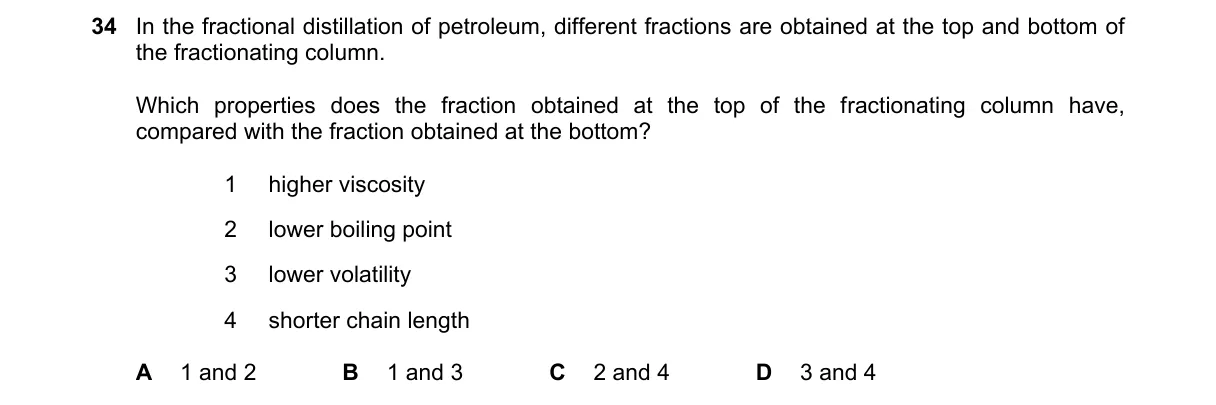
Answer choices
- A1 and 2
- B1 and 3
- C2 and 4
- D3 and 4
Explanation
Lighter Fractions Rise in Fractional Distillation
Steps:
- Crude oil contains hydrocarbons of varying chain lengths, with shorter chains having lower boiling points.
- In the fractionating column, heat vaporizes components, and those with lower boiling points rise to the cooler top.
- Top fractions condense first, consisting of shorter-chain molecules like gases and petrol.
- Bottom fractions are heavier, longer-chain residues like bitumen with higher boiling points.
Why C is correct:
- Shorter chains at the top have weaker intermolecular forces, leading to lower boiling points and shorter lengths, as defined by hydrocarbon boiling trends.
Why the others are wrong:
- A: Top fractions have lower viscosity due to smaller molecules, not higher.
- B: Top fractions have higher volatility from easier vaporization, not lower.
- D: Top fractions have higher volatility despite shorter chains.
Final answer: C
Topic: Fuels
Practice more O Levels/IGCSE Chemistry (5070) questions on mMCQ.me