O Levels/IGCSE Chemistry (5070)•5070/12/O/N/23
O Levels/IGCSE Chemistry (5070) — 5070/12/O/N/23, Question 16
Two methods used by students to measure the rate of a reaction are the 'disappearing cross' method and the 'loss of mass' method. For the 'disappearing cross' method, the student measures the time taken for the disappearing cross. For the 'loss of mass' method, the student measures the loss of mass over a known time. The rates of two reactions are investigated. Reaction 1: When aqueous silver nitrate is added to chlorobutane dissolved in ethanol. Reaction 2: Pieces of solid calcium carbonate are added to dilute hydrochloric acid. Which method should be used for each reaction?
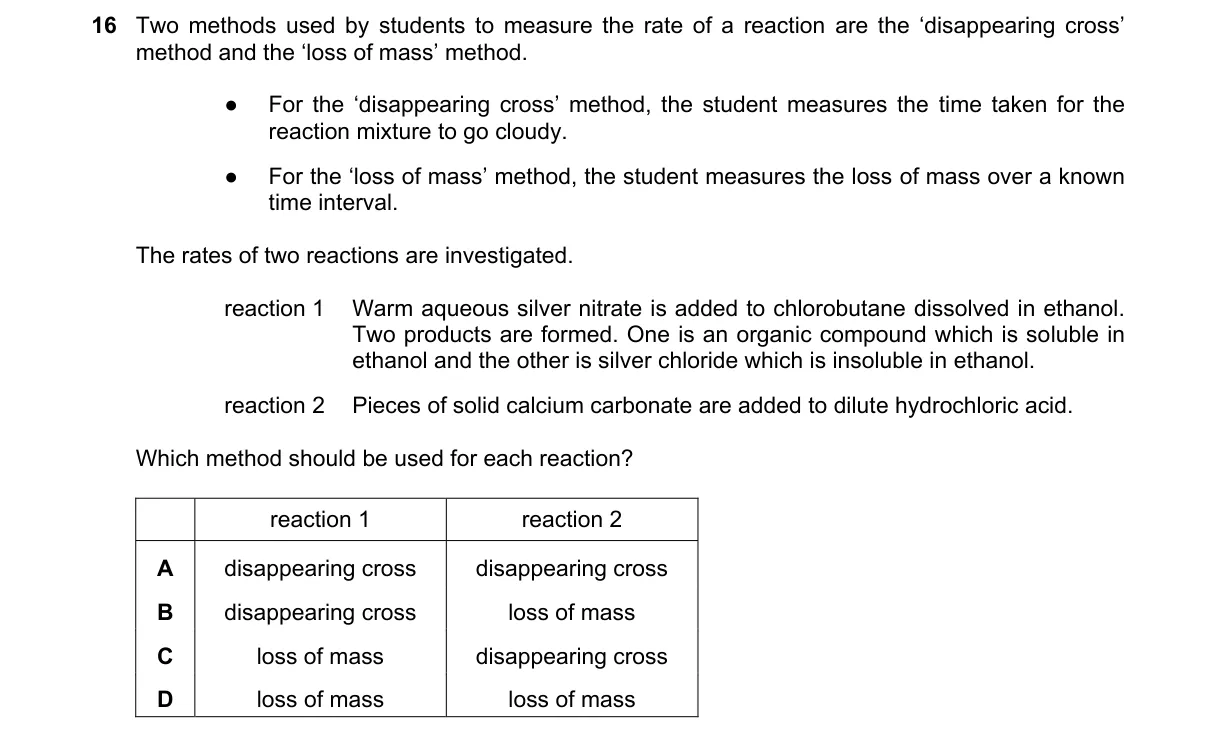
Answer choices
- Adisappearing cross disappearing cross
- Bloss of mass loss of mass
- Closs of mass disappearing cross
- Dloss of mass loss of mass
Explanation
Matching rate measurement methods to reaction products Steps:
- Reaction 1 produces AgCl precipitate, which clouds the solution and obscures a cross underneath the container.
- Reaction 2 produces CO2 gas, causing measurable mass loss as the gas escapes.
- Disappearing cross method tracks time for visibility loss due to precipitate in Reaction 1.
- Loss of mass method tracks mass decrease over time due to gas in Reaction 2.
Why D is correct:
- D pairs disappearing cross with Reaction 1's precipitate (obscures view per method definition) and loss of mass with Reaction 2's gas (mass change from escaping CO2).
Why the others are wrong:
- A: Disappearing cross fails for Reaction 2—no precipitate, so cross stays visible.
- B: Loss of mass fails for Reaction 1—no gas, so no mass change.
- C: Loss of mass fails for Reaction 1 (no gas); disappearing cross fails for Reaction 2 (no clouding).
Final answer: D
Topic: Rate of reaction
Practice more O Levels/IGCSE Chemistry (5070) questions on mMCQ.me