O Levels/IGCSE Chemistry (5070)•5070/12/O/N/23
O Levels/IGCSE Chemistry (5070) — 5070/12/O/N/23, Question 14
Nitrogen and oxygen react as shown. N2(g) + 2O2(g) -> 2NO2(g) The enthalpy change for the reaction shown is +66 kJ. If two moles of nitrogen and two moles of oxygen are used, what will be the enthalpy change?
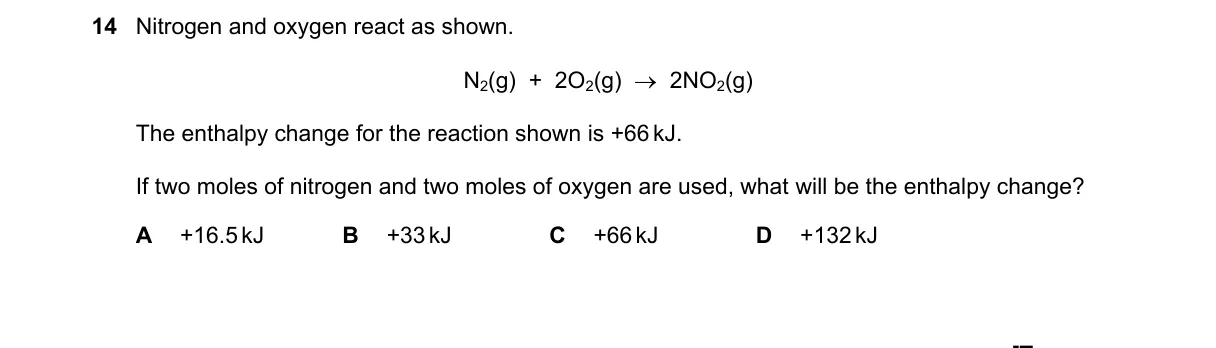
Answer choices
- A+16 kJ
- B+33 kJ
- C+66 kJ
- D+132 kJ
Explanation
Enthalpy change scales with reaction extent based on limiting reactant
Steps:
- The given ΔH = +66 kJ is for 1 mol N2 + 2 mol O2 → 2 NO2.
- With 2 mol N2 and 2 mol O2 available, O2 is limiting and supports reaction of 1 mol N2.
- The amounts used match exactly one mole of the reaction as written.
- Thus, ΔH = +66 kJ for the process.
Why C is correct:
- Enthalpy is an extensive property; here, the reaction extent is 1 (stoichiometric match), so ΔH equals the given value per the reaction equation.
Why the others are wrong:
- A: +16 kJ – No stoichiometric basis for dividing by 4.
- B: +33 kJ – No basis for halving the value.
- D: +132 kJ – Assumes full reaction of 2 mol N2, ignoring O2 limitation.
Final answer: C
Topic: Exothermic and endothermic reactions
Practice more O Levels/IGCSE Chemistry (5070) questions on mMCQ.me