O Levels/IGCSE Chemistry (5070)•5070/12/O/N/23
O Levels/IGCSE Chemistry (5070) — 5070/12/O/N/23, Question 13
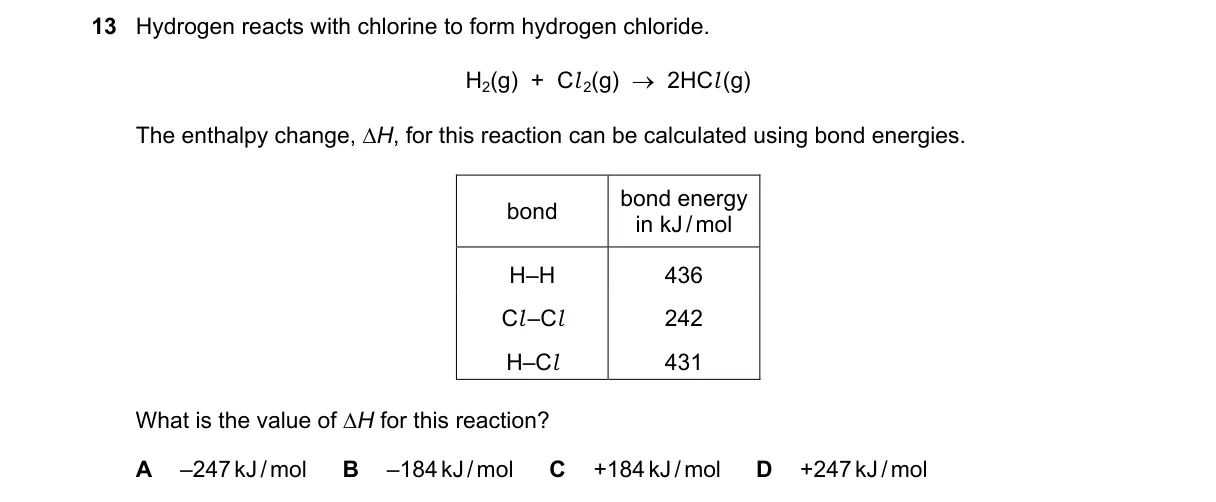
Hydrogen reacts with chlorine to form hydrogen chloride. H₂(g) + Cl₂(g) → 2HCl(g) The enthalpy change, ΔH, for this reaction can be calculated using bond energies. Bond | Bond energy (kJ/mol) H-H 436 Cl-Cl 242 H-Cl 431 What is the value of ΔH
Answer choices
- A-247 kJ/mol
- B-184 kJ/mol
- C+184 kJ/mol
- D+247 kJ/mol
Explanation
Enthalpy Change Using Bond Energies
Steps:
- Identify bonds broken: one H-H (436 kJ/mol) and one Cl-Cl (242 kJ/mol); total energy input = 436 + 242 = 678 kJ/mol.
- Identify bonds formed: two H-Cl (431 kJ/mol each); total energy released = 2 × 431 = 862 kJ/mol.
- Calculate ΔH = energy to break bonds - energy from forming bonds = 678 - 862 = -184 kJ/mol.
- The negative value indicates an exothermic reaction.
Why B is correct:
- ΔH = -184 kJ/mol matches the formula for bond enthalpy change, where breaking bonds requires energy and forming bonds releases more energy.
Why the others are wrong:
- A: Incorrect sign; -247 reverses the exothermic nature.
- C: Positive value (+184) ignores the net energy release from bond formation.
- D: +247 miscalculates the difference and sign.
Final answer: B
Topic: Exothermic and endothermic reactions
Practice more O Levels/IGCSE Chemistry (5070) questions on mMCQ.me