O Levels/IGCSE Chemistry (5070)•5070/11/O/N/23
O Levels/IGCSE Chemistry (5070) — 5070/11/O/N/23, Question 40
A student does two experiments. In experiment 1, ammonium carbonate is reacted with dilute hydrochloric acid. In experiment 2, ammonia gas evolved is tested with damp blue litmus paper and damp red litmus paper. Which row correctly shows the colour of both pieces of litmus paper at the end of each experiment?
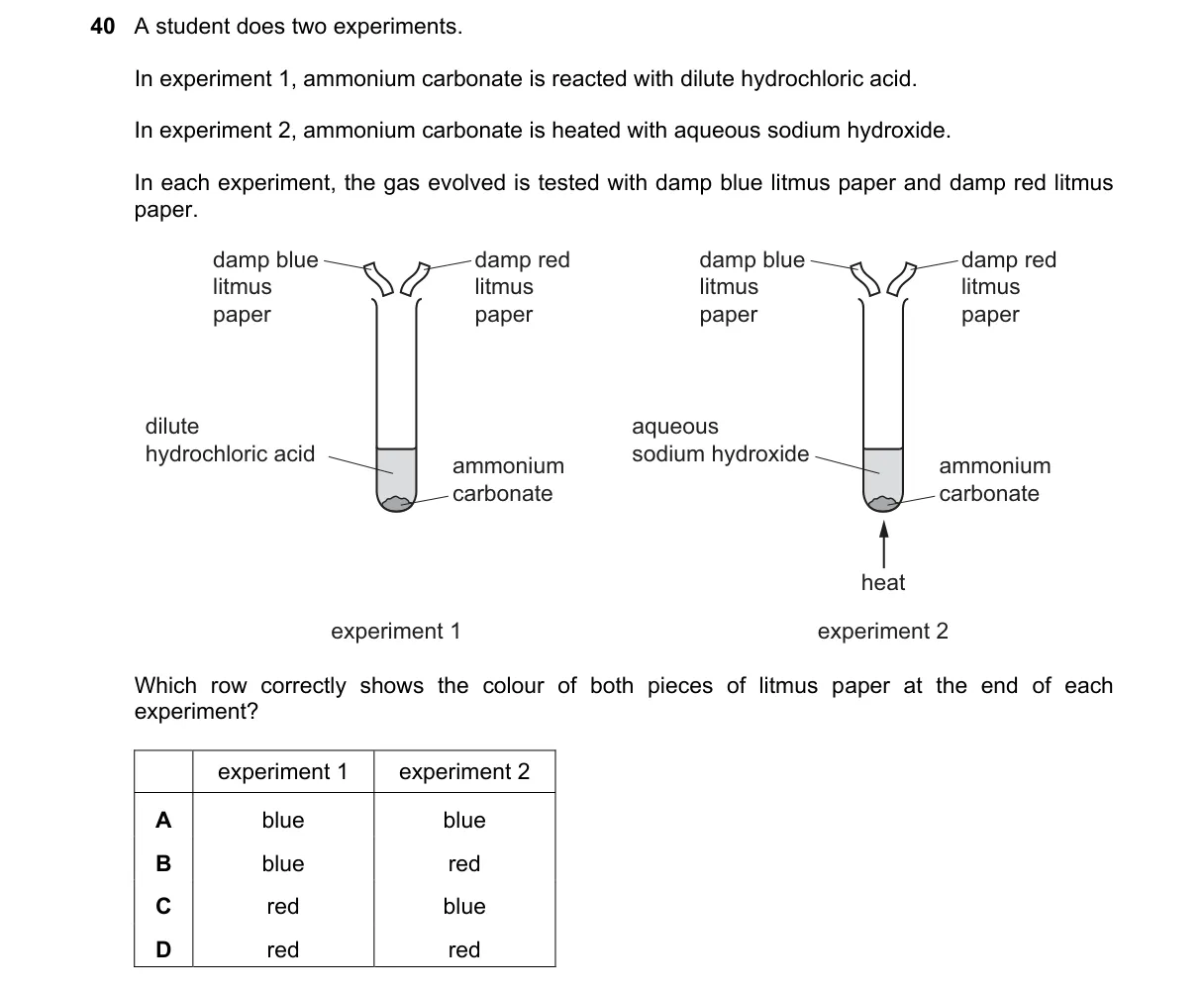
Answer choices
- Aexperiment 1: blue, experiment 2: blue
- Bexperiment 1: red, experiment 2: red
- Cexperiment 1: red, experiment 2: blue
- Dexperiment 1: red, experiment 2: red
Explanation
Litmus tests reveal acid-base nature of reaction products and gases
Steps:
- Ammonium carbonate reacts with dilute HCl to form ammonium chloride, CO2, and water, yielding an acidic solution from excess strong acid.
- In experiment 1, acidic solution contacts litmus: blue turns red, red stays red, so both red.
- In experiment 2, evolved ammonia gas (NH3) is basic due to its ability to accept protons.
- Basic ammonia contacts litmus: red turns blue, blue stays blue, so both blue.
Why C is correct:
- Litmus color change follows acid-base indicator rules: acids protonate to red, bases deprotonate to blue; HCl mixture is acidic (red), NH3 gas is basic (blue).
Why the others are wrong:
- A: Experiment 1 mixture is acidic, not basic, so not both blue.
- B: Experiment 2 ammonia is basic, not acidic, so not both red.
- D: Experiment 2 ammonia is basic, not acidic, so not both red.
Final answer: C
Topic: The characteristic properties of acids and bases
Practice more O Levels/IGCSE Chemistry (5070) questions on mMCQ.me