O Levels/IGCSE Chemistry (5070)•5070/11/O/N/23
O Levels/IGCSE Chemistry (5070) — 5070/11/O/N/23, Question 2
Data about two compounds is given. Both compounds have simple molecular structure. Compound Boiling point /°C H2S -85 PCl3 -61 Two bottles are placed close together inside a large container at a temperature of 90°C. A detector is placed 1.0 m from the two bottles. One bottle contains 1g of H2S, the other bottle contains 1g of PCl3. The two bottles are opened at the same time. Which compound reaches the detector first?
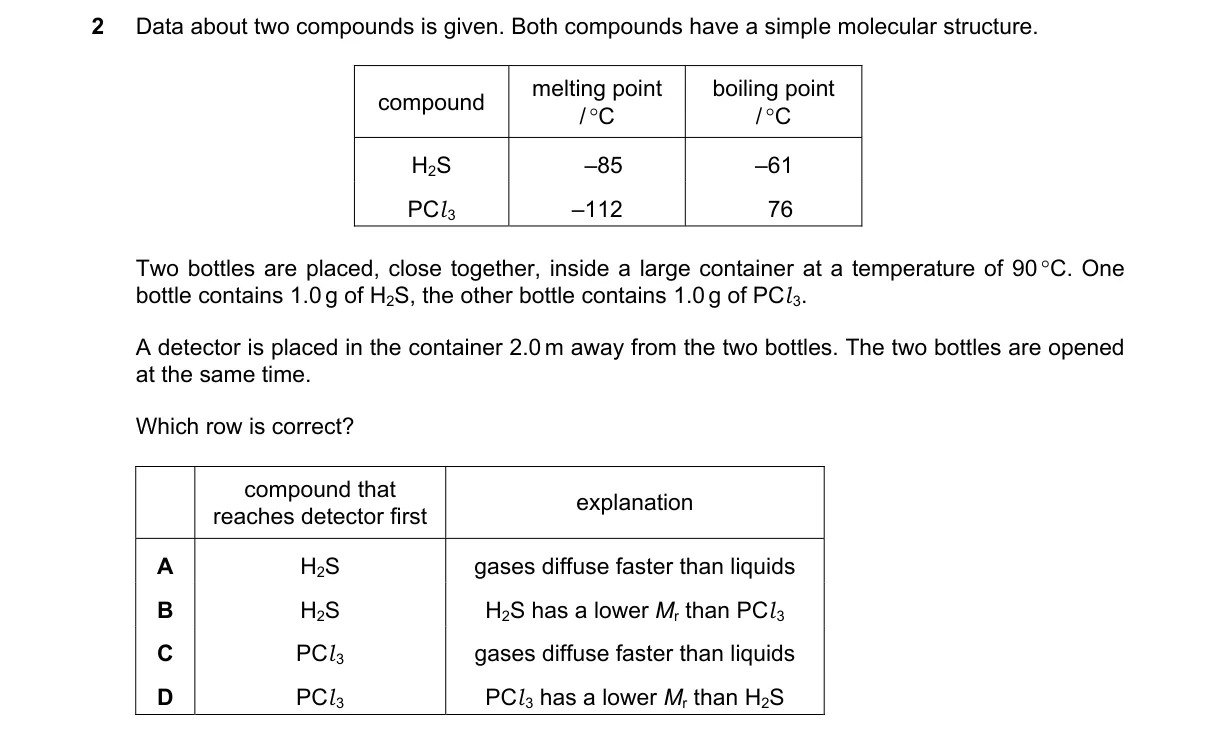
Answer choices
- AH2S gases diffuse faster than liquids
- BPCl3 H2S has a lower M than PCl3
- CH2S H2S has a lower M than PCl3
- DPCl3 PCl3 has a lower M than H2S
Explanation
Gas diffusion follows Graham's law Steps:
- Confirm both H2S and PCl3 are gases at 90°C, exceeding their boiling points (-85°C and -61°C).
- Apply Graham's law: diffusion rate ∝ 1/√M, where M is molar mass.
- Calculate molar masses: H2S = 34 g/mol, PCl3 ≈ 137 g/mol.
- H2S has lower M, so higher diffusion rate, reaching detector first despite equal masses.
Why B is correct:
- B states PCl3 reaches second because H2S has lower M (34 vs. 137 g/mol), aligning with Graham's law where lower M yields faster diffusion.
Why the others are wrong:
- A: Both compounds are gases at 90°C, not one gas and one liquid.
- C: Incorrectly assigns H2S as first but repeats reason without specifying compound order.
- D: PCl3 has higher M than H2S, so slower diffusion.
Final answer: B
Topic: Diffusion
Practice more O Levels/IGCSE Chemistry (5070) questions on mMCQ.me