O Levels/IGCSE Chemistry (5070)•5070/11/O/N/23
O Levels/IGCSE Chemistry (5070) — 5070/11/O/N/23, Question 18
Aqueous bromine is in equilibrium. Br2(aq) + H2O(l) ⇌ Br-(aq) + HOBr(aq) Aqueous bromine is orange colour. The species on the right-hand side of the equation are colourless. Changes are made to three separate portions of the equilibrium mixture. Which row shows how the colour of the mixture changes when a small amount of each substance is added?
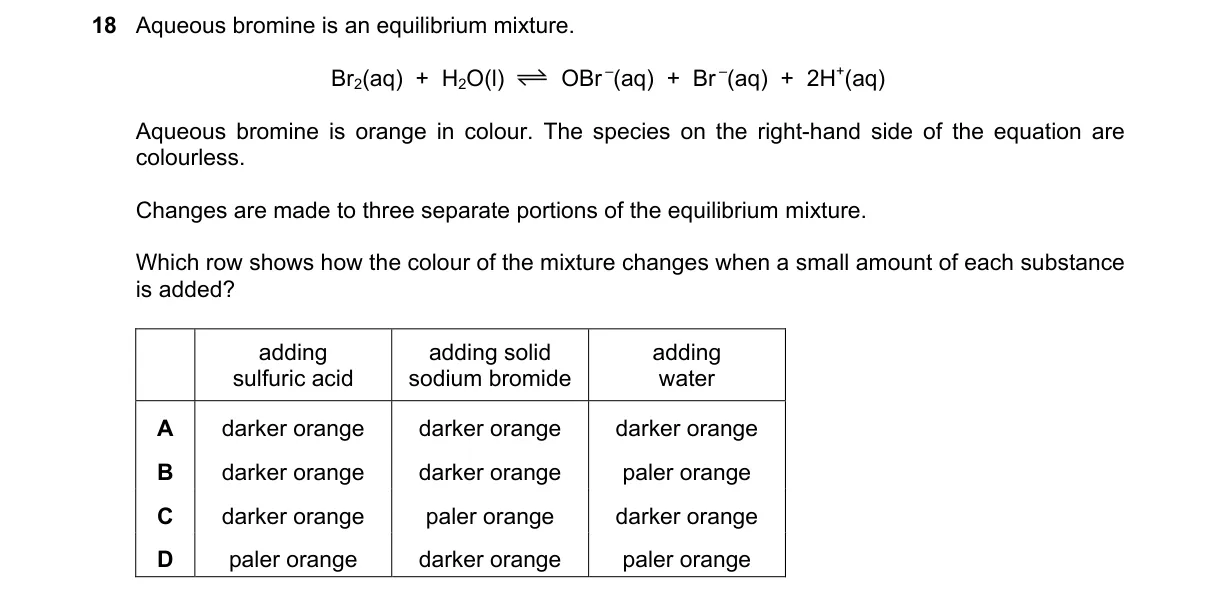
Answer choices
- Adarker orange, paler orange, darker orange
- Bdarker orange, paler orange, paler orange
- Cpaler orange, darker orange, paler orange
- Dpaler orange, darker orange, darker orange
Explanation
Le Chatelier's principle governs equilibrium shifts Steps:
- Identify the equilibrium: Br₂(aq) + H₂O(l) ⇌ Br⁻(aq) + HOBr(aq); orange color from Br₂(aq), products colorless.
- Adding Br⁻ (first substance): increases product concentration, shifts equilibrium left, produces more Br₂, darker orange.
- Adding OH⁻ (second substance): neutralizes implied H⁺ from full reaction (Br₂ + H₂O ⇌ HOBr + H⁺ + Br⁻), shifts right, consumes Br₂, paler orange.
- Adding H₂O (third substance): increases reactant concentration, shifts equilibrium right, consumes Br₂, paler orange.
Why B is correct:
- Matches predictions: adding Br⁻ darkens (left shift), adding OH⁻ and H₂O pale (right shifts), per Le Chatelier's principle.
Why the others are wrong:
- A: Incorrectly predicts darkening for third addition, ignoring H₂O's right shift.
- C: Wrongly predicts paler for first (Br⁻ addition darkens).
- D: Wrongly predicts paler for first and darkening for second (OH⁻ pales).
Final answer: B
Topic: Reversible reactions and equilibrium
Practice more O Levels/IGCSE Chemistry (5070) questions on mMCQ.me