O Levels/IGCSE Chemistry (5070)•5070/11/O/N/23
O Levels/IGCSE Chemistry (5070) — 5070/11/O/N/23, Question 16
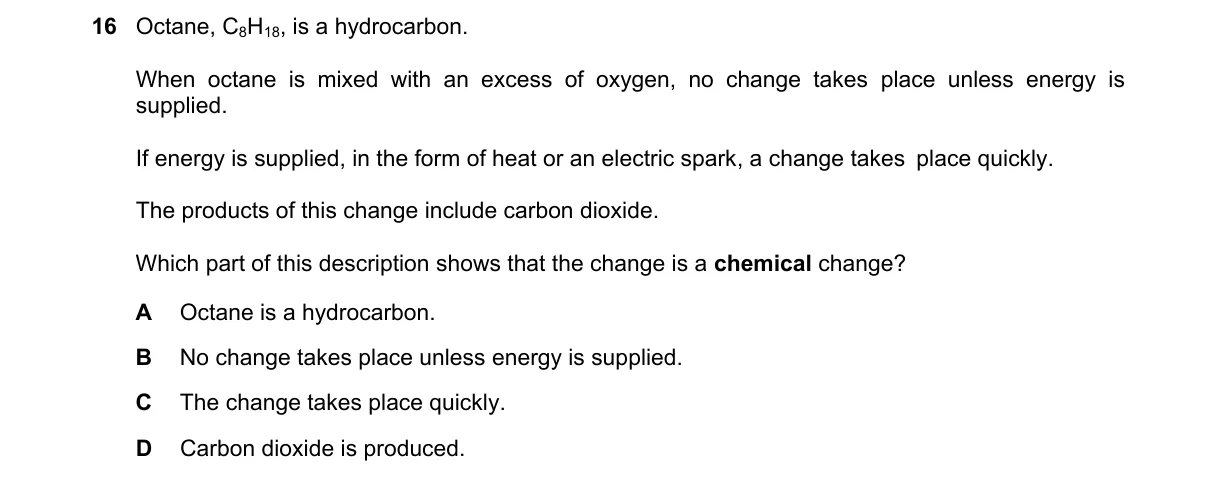
Octane, C8H18, is a hydrocarbon. When octane is mixed with an excess of oxygen, no change takes place unless energy is supplied in the form of heat or an electric spark, a change takes place quickly. The products of this change include carbon dioxide. Which part of description shows that the change is chemical?
Answer choices
- AOctane is a hydrocarbon
- BNo change takes place unless energy is supplied
- CThe change takes place quickly
- DCarbon dioxide is produced
Explanation
Chemical changes form new substances
Steps:
- Recall that chemical changes involve breaking and forming bonds to create new substances, unlike physical changes which alter form without new products.
- Analyze the description: octane (C8H18) reacts with oxygen to produce carbon dioxide (CO2), indicating bond rearrangement.
- Evaluate options: identify which describes new substance formation versus other reaction aspects.
- Select the option tied to product formation as evidence of chemical nature.
Why D is correct:
- Chemical changes are defined by producing new substances with different properties; CO2 is a new compound from octane and oxygen, per the law of conservation of mass in reactions.
Why the others are wrong:
- A: Classifies octane as a hydrocarbon but provides no evidence of change type.
- B: Describes energy requirement for initiation, common to both chemical and physical processes like melting.
- C: Indicates reaction speed but doesn't distinguish chemical (new bonds) from physical (state change) alterations.
Final answer: D
Topic: Physical and chemical changes
Practice more O Levels/IGCSE Chemistry (5070) questions on mMCQ.me