O Levels/IGCSE Chemistry (5070)•5070/12/O/N/22
O Levels/IGCSE Chemistry (5070) — 5070/12/O/N/22, Question 3
The following tests are carried out on a sample of green crystals. Aqueous sodium hydroxide is added to the first portion. A green precipitate forms. The excess aqueous sodium hydroxide solution is heated and a gas is formed which turns litmus paper blue. A white precipitate is added to the second portion followed by aqueous barium nitrate. Which three ions are present in the green crystals?
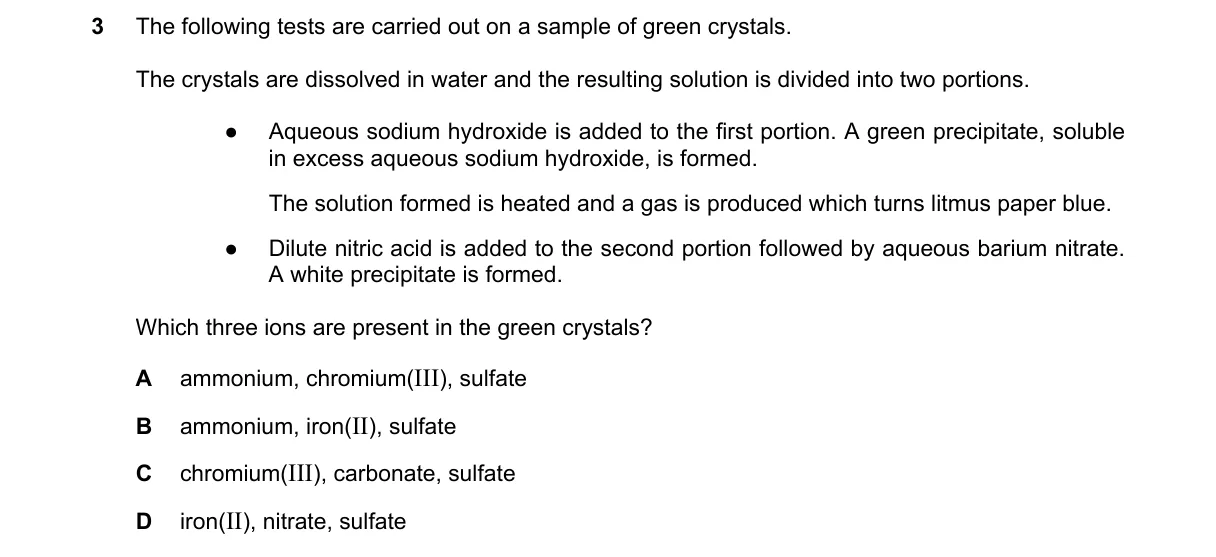
Answer choices
- Aammonium, chromium(III), sulfate
- Bammonium, iron(II), sulfate
- Cchromium(III), carbonate, sulfate
- Diron(II), nitrate, sulfate
Explanation
Ion identification via precipitation and gas tests
Steps:
- Green precipitate with NaOH indicates Cr³⁺, as Cr(OH)₃ is green (Fe²⁺ also possible but tested further).
- Ammonia gas (turns litmus blue) on heating excess NaOH confirms NH₄⁺, via NH₄⁺ + OH⁻ → NH₃ + H₂O.
- White precipitate with Ba(NO₃)₂ after acidification indicates SO₄²⁻, as BaSO₄ is insoluble white.
- Combination matches NH₄⁺, Cr³⁺, SO₄²⁻ in green crystals (e.g., (NH₄)₂Cr₂(SO₄)₃·12H₂O).
Why A is correct:
- Tests align with NH₄⁺ (ammonia evolution), Cr³⁺ (green Cr(OH)₃), and SO₄²⁻ (BaSO₄ formation per solubility rules).
Why the others are wrong:
- B: Fe²⁺ gives green Fe(OH)₂, SO₄²⁻ fits, but no NH₄⁺ for ammonia gas.
- C: Cr³⁺ fits green ppt, SO₄²⁻ fits BaSO₄, but CO₃²⁻ yields CO₂ (not ammonia) with acid/heat.
- D: Fe²⁺ fits green ppt, SO₄²⁻ fits, but NO₃⁻ produces no ammonia gas with NaOH.
Final answer: A
Topic: Identification of ions and gases
Practice more O Levels/IGCSE Chemistry (5070) questions on mMCQ.me