O Levels/IGCSE Chemistry (5070)•5070/12/O/N/22
O Levels/IGCSE Chemistry (5070) — 5070/12/O/N/22, Question 22
Carbonates react with dilute acids to produce carbon dioxide. A student uses carbonate and 100 cm³ of 0.1 mol/dm³ acid and measures the volume of gas produced at regular time intervals. The results give line X on the graph. The student repeats the experiment using 50 cm³ of 0.2 mol/dm³ acid whilst keeping everything else the same. Which line shows the results of the second experiment?
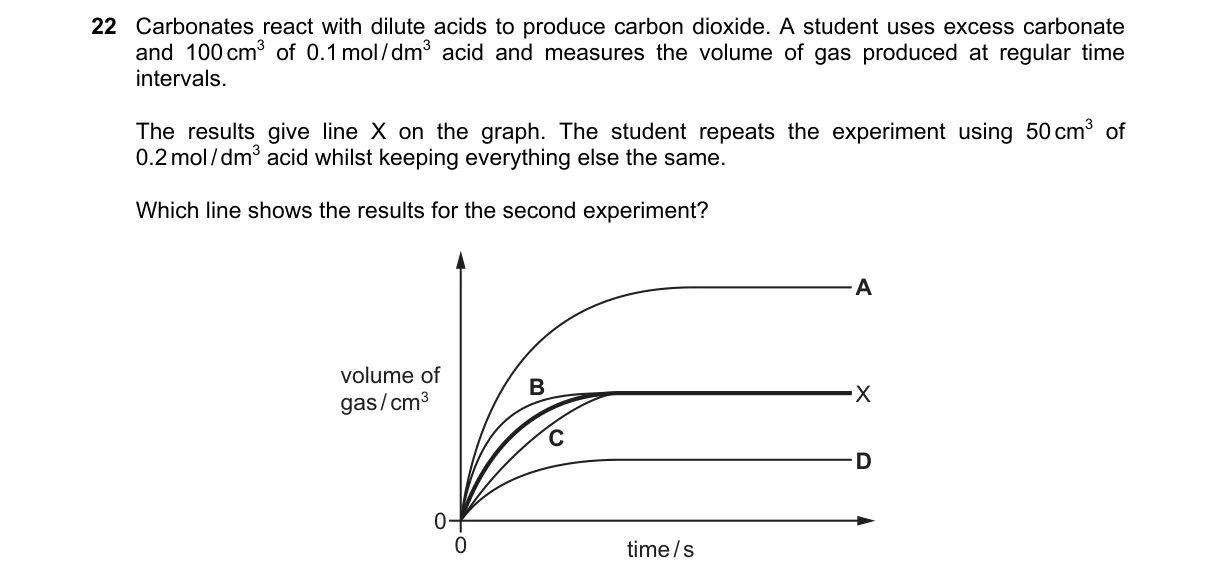
Answer choices
- AOption A
- BOption B
- COption C
- DOption D
Explanation
Same acid moles yield equal total CO2, but higher concentration speeds up the reaction rate
Steps:
- Calculate acid moles in first experiment: 100 cm³ (0.1 dm³) × 0.1 mol/dm³ = 0.01 mol.
- Second experiment: 50 cm³ (0.05 dm³) × 0.2 mol/dm³ = 0.01 mol, identical amount.
- Same carbonate amount means equal total CO2 produced in both.
- Higher acid concentration in second experiment increases reaction rate, producing steeper volume-time curve.
Why B is correct:
- B shows steeper initial slope to same final volume, as rate law states reaction rate ∝ acid concentration.
Why the others are wrong:
- A: Shows half total volume, ignoring equal moles of acid.
- C: Depicts slower rate, contradicting higher concentration effect.
- D: Indicates different final volume, violating equal reactant moles.
Final answer: B
Topic: Rate of reaction
Practice more O Levels/IGCSE Chemistry (5070) questions on mMCQ.me