O Levels/IGCSE Chemistry (5070)•5070/12/O/N/22
O Levels/IGCSE Chemistry (5070) — 5070/12/O/N/22, Question 17
The table gives some statements about electrolysis and the reason each statement is true. Which row shows a correct statement and the correct reason why the statement is true?
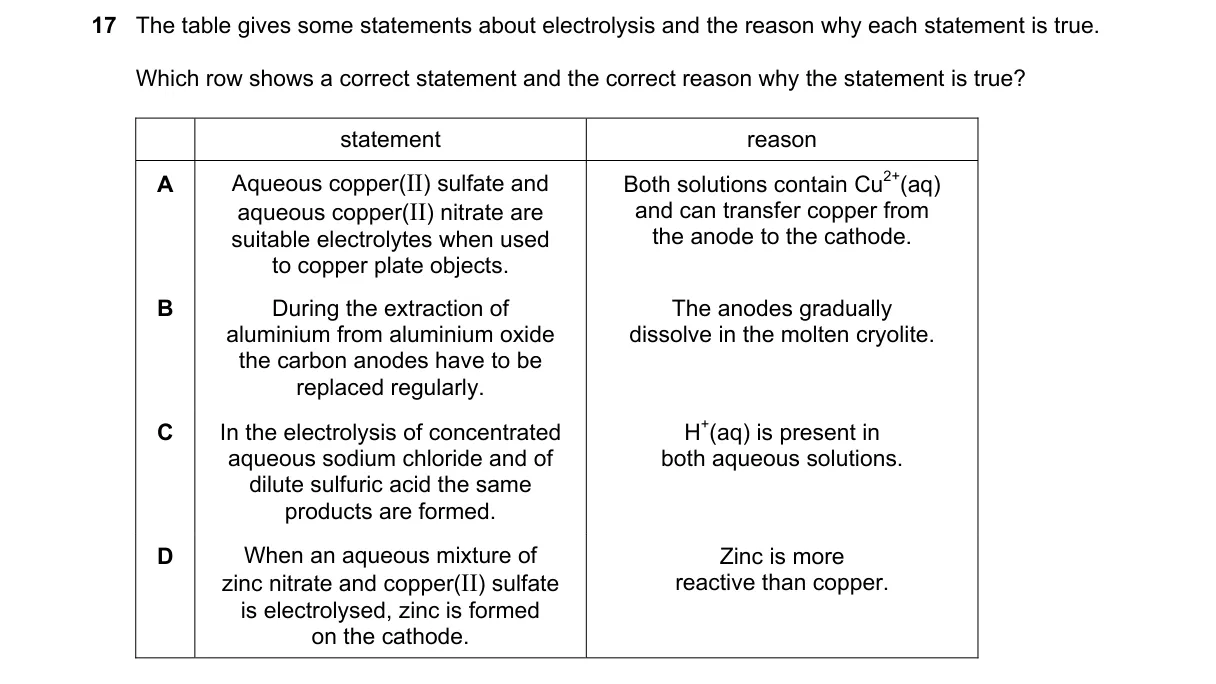
Answer choices
- AAqueous copper(II) sulfate and aqueous copper(II) nitrate are used. Both solutions contain Cu²⁺(aq) and can transfer copper from anode to cathode.
- BDuring electrolysis of aluminum oxide, cryolite is used. The anodes gradually
- CIn the electrolysis of concentrated sulfuric acid the same both(aq) solutions. H₂SO₄ is present in
- DWhen aqueous mixture of zinc nitrate and copper(II) sulfate is electrolyzed on the cathode. Zinc is more reactive than copper.
Explanation
Correct Electrolysis Statement and Reason
Steps:
- Evaluate option A: Both solutions have Cu²⁺ ions, enabling copper deposition at cathode and dissolution at anode in electrolysis.
- Evaluate option B: Cryolite lowers melting point of aluminum oxide, but incomplete reason about anodes (likely carbon oxidation) is cut off and unclear.
- Evaluate option C: Incomplete text on sulfuric acid electrolysis; mentions H₂SO₄ presence but garbled, lacks full reason.
- Select A as only complete, accurate pairing of statement and explanation.
Why A is correct:
- In electrolysis of Cu²⁺ solutions with copper electrodes, Cu²⁺(aq) + 2e⁻ → Cu(s) at cathode deposits copper, while anode oxidation transfers Cu atoms, per Faraday's laws of electrolysis.
Why the others are wrong:
- B: Incomplete; cryolite aids melting, but anode reason (e.g., carbon consumption) is missing or incorrect.
- C: Text is garbled and incomplete; no clear reason for sulfuric acid electrolysis products.
- D: Incomplete; zinc reactivity doesn't explain cathode deposition—Cu²⁺ reduces preferentially over Zn²⁺ due to standard electrode potentials.
Final answer: A
Topic: Electrolysis
Practice more O Levels/IGCSE Chemistry (5070) questions on mMCQ.me