O Levels/IGCSE Chemistry (5070)•5070/12/O/N/22
O Levels/IGCSE Chemistry (5070) — 5070/12/O/N/22, Question 14
Which compound has an empirical formula that is different from its molecular formula?
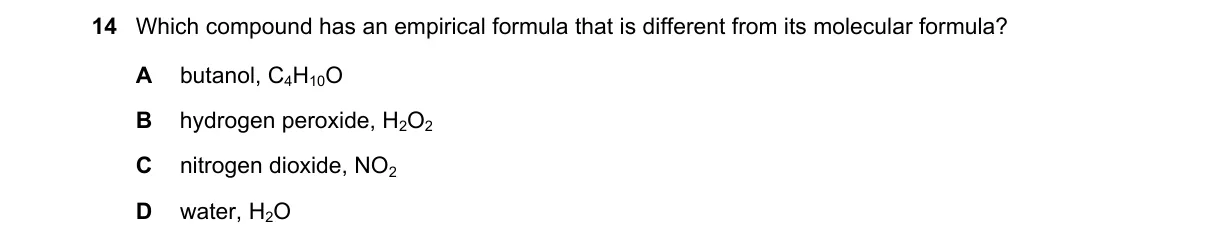
Answer choices
- Abutanol, C4H9OH
- Bhydrogen peroxide, H2O2
- Cnitrogen dioxide, NO2
- Dwater, H2O
Explanation
Empirical formula simplifies molecular formula to lowest ratio Steps:
- Define empirical formula as simplest whole-number ratio of atoms; molecular formula as actual atom count.
- For each compound, derive empirical formula by dividing subscripts by greatest common divisor.
- Compare empirical to given molecular formula for differences.
- Select compound where they differ.
Why B is correct:
- H2O2 molecular formula simplifies to HO empirical (divide by 2), differing from actual structure.
Why the others are wrong:
- A: C4H9OH (or C4H10O) already simplest ratio, so empirical matches molecular.
- C: NO2 subscripts (1:2) have no common divisor >1, so empirical matches molecular.
- D: H2O subscripts (2:1) already simplest, so empirical matches molecular.
Final answer: B
Topic: Formulae
Practice more O Levels/IGCSE Chemistry (5070) questions on mMCQ.me