O Levels/IGCSE Chemistry (5070)•5070/12/O/N/22
O Levels/IGCSE Chemistry (5070) — 5070/12/O/N/22, Question 11
Boron trifluoride, BF₃, is a simple molecule. There are three covalent bonds in each BF₃ molecule. Each of these bonds is made by sharing one electron from the boron atom and one electron from fluorine atom in boron trifluoride. What is unusual about the bonding in boron trifluoride?
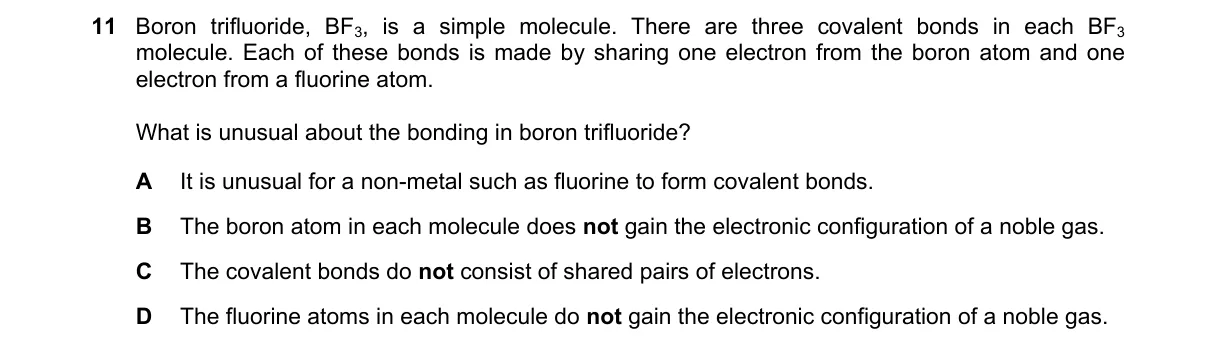
Answer choices
- AIt is unusual for a non-metal such as boron to form covalent bonds.
- BThe boron atom in each molecule does not gain the electronic configuration of a noble gas.
- CThe covalent bonds do not consist of shared electrons.
- DThe fluorine atom in each molecule do not gain the electronic configuration of a noble gas.
Explanation
Boron achieves only a sextet, not an octet, in BF₃
Steps:
- Boron has 3 valence electrons and forms 3 single bonds with fluorine, sharing 2 electrons per bond.
- This gives boron 6 electrons in its valence shell (3 from itself + 3 from bonds).
- Noble gas configuration requires 8 electrons (octet rule) for stability, like neon.
- Boron's incomplete octet makes the bonding unusual.
Why B is correct:
- Boron ends with 6 valence electrons, violating the octet rule that atoms seek 8 electrons for noble gas stability.
Why the others are wrong:
- A: Non-metals routinely form covalent bonds, as in H₂O or CO₂.
- C: Covalent bonds are defined by shared electron pairs between atoms.
- D: Each fluorine gains 8 electrons, achieving neon's configuration.
Final answer: B
Topic: Simple molecules and covalent bonds
Practice more O Levels/IGCSE Chemistry (5070) questions on mMCQ.me