O Levels/IGCSE Chemistry (5070)•5070/11/O/N/22
O Levels/IGCSE Chemistry (5070) — 5070/11/O/N/22, Question 28
Sodium sulfate, Na2SO4, and sodium hydrogensulfate, NaHSO4, can both be prepared using aqueous sodium hydroxide and sulfuric acid. NaOH(aq) + H2SO4(aq) → NaHSO4(aq) + H2O(l) 2NaOH(aq) + H2SO4(aq) → Na2SO4(aq) + 2H2O(l) 50 cm³ of 1 mol dm⁻³ sulfuric acid is required to prepare a sample of sodium sulfate and a sample of sodium hydrogensulfate. Which row and column shows the volume of sodium hydroxide required to make each?
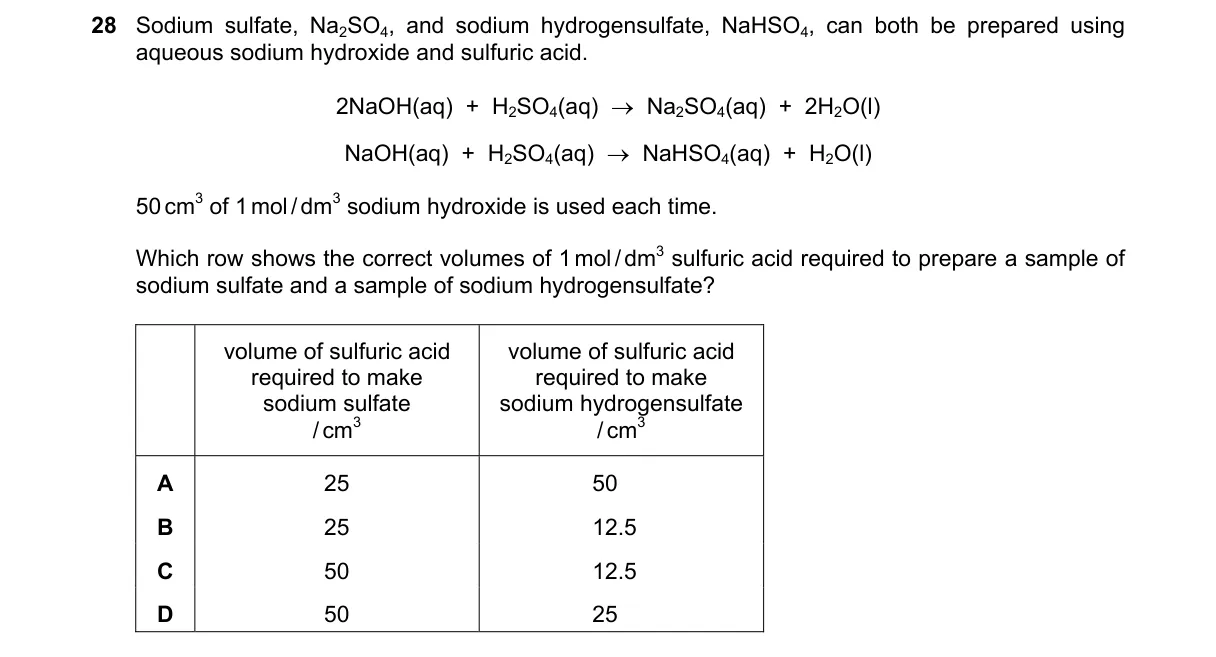
Answer choices
- A25, 50
- B25, 12.5
- C50, 25
- D50, 25
Explanation
Stoichiometry of acid-base reactions determines NaOH volumes Steps:
- Moles of H₂SO₄ used for each sample: 50 cm³ × 1 mol dm⁻³ = 0.05 mol.
- For NaHSO₄ (1:1 NaOH:H₂SO₄ ratio): 0.05 mol NaOH required.
- For Na₂SO₄ (2:1 NaOH:H₂SO₄ ratio): 0.10 mol NaOH required.
- With 2 mol dm⁻³ NaOH, volumes are 0.05/2 = 25 cm³ (NaHSO₄) and 0.10/2 = 50 cm³ (Na₂SO₄).
Why A is correct:
- Matches 25 cm³ for NaHSO₄ and 50 cm³ for Na₂SO₄ per the 1:1 and 2:1 molar ratios.
Why the others are wrong:
- B: 12.5 cm³ underestimates NaOH for Na₂SO₄ (ignores 2:1 ratio).
- C: Reverses volumes, assigning 50 cm³ to NaHSO₄ (should be 1:1, not 2:1).
- D: Identical to C, incorrect reversal of volumes.
Final answer: A
Topic: The mole and the Avogadro constant
Practice more O Levels/IGCSE Chemistry (5070) questions on mMCQ.me