O Levels/IGCSE Chemistry (5070)•5070/11/O/N/22
O Levels/IGCSE Chemistry (5070) — 5070/11/O/N/22, Question 10
Elements X and Y form compound XY. Element Y has more electrons in its outer shell. Compound XY conducts electricity in the molten state. Which row correctly states the electron change that occurs during the reaction and the type of bonding in compound XY?
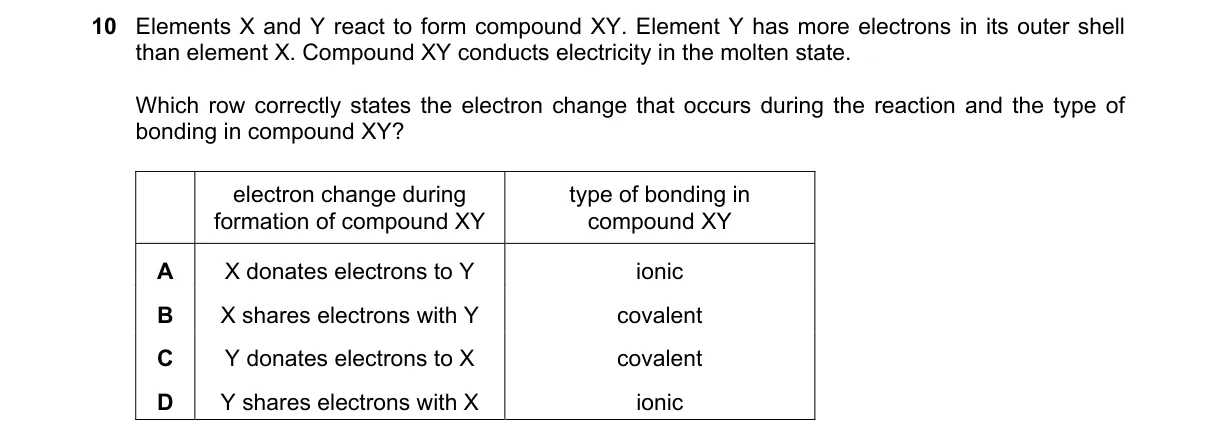
Answer choices
- AX donates electrons to Y; ionic
- BY donates electrons to X; covalent
- CX shares electrons with Y; ionic
- DY shares electrons with X; covalent
Explanation
Ionic bonding via electron transfer from X to Y
Steps:
- Element Y has more outer electrons, indicating higher electronegativity, so it gains electrons.
- XY conducts electricity when molten, characteristic of ionic compounds with free ions.
- Ionic bonding involves electron donation from less electronegative X to more electronegative Y.
- Thus, X donates to Y, forming ionic XY.
Why A is correct:
- Ionic bonding definition: complete electron transfer creates oppositely charged ions that conduct in molten state.
Why the others are wrong:
- B: Covalent bonding does not conduct electricity due to lack of ions.
- C: Electron sharing defines covalent bonding, not ionic.
- D: Electron sharing indicates covalent bonding; Y with more outer electrons would not donate.
Final answer: A
Topic: Ion and ionic bonds
Practice more O Levels/IGCSE Chemistry (5070) questions on mMCQ.me