O Levels/IGCSE Chemistry (5070)•5070/12/O/N/21
O Levels/IGCSE Chemistry (5070) — 5070/12/O/N/21, Question 5
When aqueous sodium hydroxide is added to aqueous compound X, a red-brown precipitate is formed. When dilute nitric acid is added to compound X, white precipitate is formed. When aqueous barium nitrate is added to aqueous compound X, white precipitate is formed. What is X?
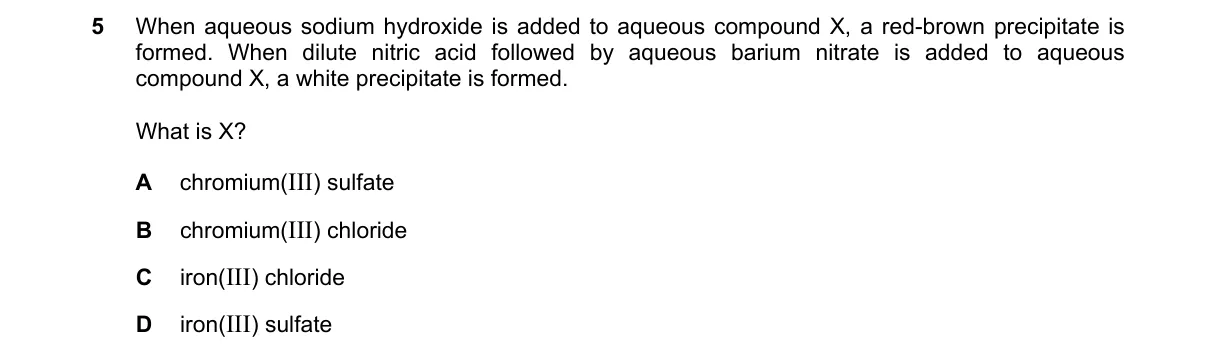
Answer choices
- Achromium(II) sulfate
- Bchromium(III) chloride
- Ciron(II) sulfate
- Diron(III) sulfate
Explanation
Precipitation tests identify Fe³⁺ and SO₄²⁻ in X Steps:
- Red-brown precipitate with NaOH indicates Fe³⁺ cation, as Fe(OH)₃ forms reddish-brown hydroxide.
- White precipitate with Ba(NO₃)₂ indicates SO₄²⁻ anion, as BaSO₄ is insoluble and white.
- White precipitate with dilute HNO₃ aligns with iron(III) sulfate behavior in acidic conditions, distinguishing from reducing ions like Cr²⁺ or Fe²⁺. Why D is correct:
- Iron(III) sulfate, Fe₂(SO₄)₃, yields red-brown Fe(OH)₃ with NaOH per solubility rules for metal hydroxides. Why the others are wrong:
- A: Chromium(II) sulfate yields blue Cr(OH)₂ with NaOH, not red-brown.
- B: Chromium(III) chloride yields gray-green Cr(OH)₃ with NaOH and no BaSO₄ with Ba(NO₃)₂, as Cl⁻ is soluble.
- C: Iron(II) sulfate yields green Fe(OH)₂ with NaOH, not red-brown. Final answer: D
Topic: Identification of ions and gases
Practice more O Levels/IGCSE Chemistry (5070) questions on mMCQ.me