O Levels/IGCSE Chemistry (5070)•5070/12/O/N/21
O Levels/IGCSE Chemistry (5070) — 5070/12/O/N/21, Question 4
An impure sample of compound X has a melting point of 120°C. X is purified and its melting point is measured again. Which row is correct?
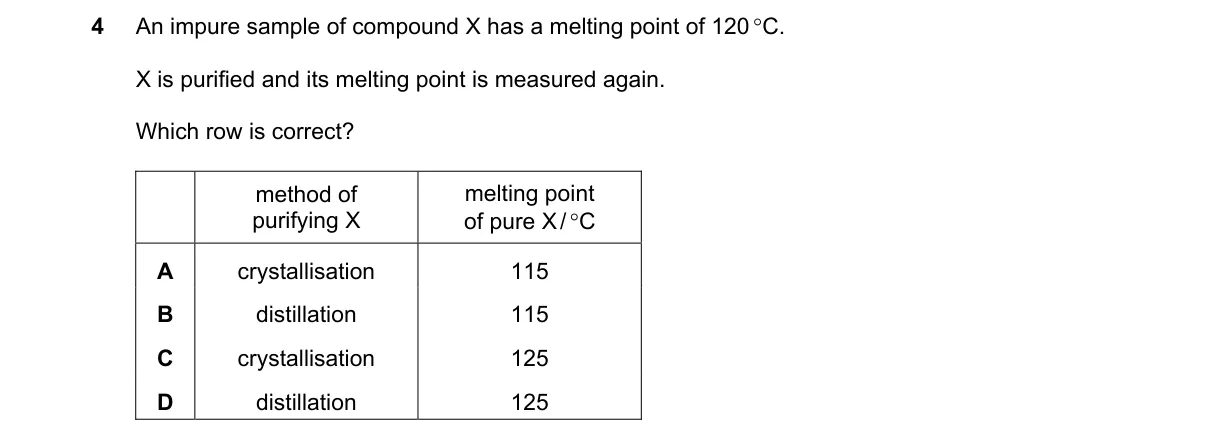
Answer choices
- Acrystallisation, 115 °C
- Bdistillation, 125 °C
- Ccrystallisation, 115 °C
- Ddistillation, 125 °C
Explanation
Purification raises melting point of solids via crystallisation Steps:
- Impure samples melt at lower temperatures due to impurities depressing the melting point.
- Purification removes impurities, increasing the melting point to the pure compound's value.
- Compound X is a solid (has melting point), so crystallisation is the appropriate purification method.
- After crystallisation, the melting point rises above 120°C, to 125°C for the pure compound.
Why C is correct:
- Crystallisation selectively purifies solids by solubility differences, raising the melting point from 120°C to 125°C as per melting point depression principle.
Why the others are wrong:
- A: Crystallisation is correct method, but 115°C is lower, contradicting melting point elevation upon purification.
- B: Distillation suits liquids by boiling point, not solids; 125°C temperature is correct but method is wrong.
- D: Distillation is unsuitable for solids; 115°C is also too low for pure compound.
Final answer: C
Topic: Separation and purification
Practice more O Levels/IGCSE Chemistry (5070) questions on mMCQ.me