O Levels/IGCSE Chemistry (5070)•5070/12/O/N/21
O Levels/IGCSE Chemistry (5070) — 5070/12/O/N/21, Question 37
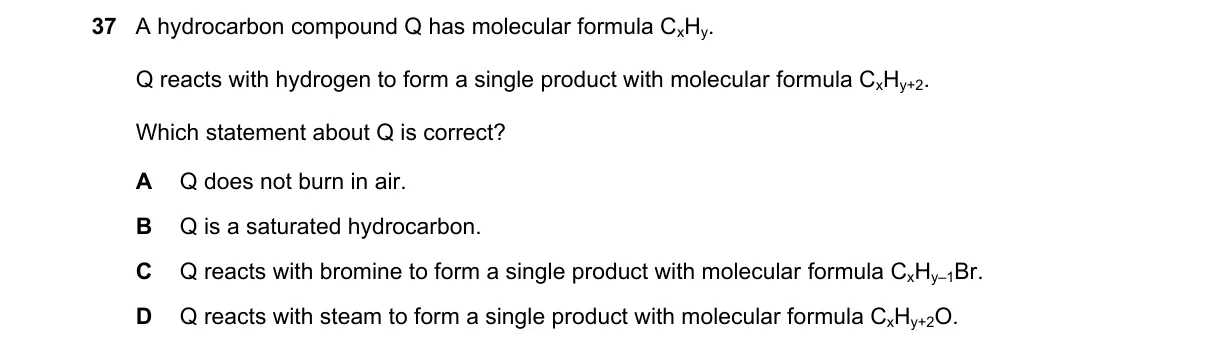
A hydrocarbon compound Q has molecular formula C4H6. Q reacts with hydrogen to form a single product with molecular formula C4H8. Which statement about Q is correct?
Answer choices
- AQ is saturated hydrocarbon.
- BQ reacts with bromine to form a single product with molecular formula C4H6Br2.
- CQ reacts with steam to form a single product with molecular formula C4H6O.
- DQ reacts with bromine to form a single product with molecular formula C4H6Br.
Explanation
Q is a terminal alkyne like 1-butyne Steps:
- Molecular formula C4H6 shows 2 degrees of unsaturation: expected hydrogens for alkane are 10, so (10-6)/2 = 2.
- Hydrogenation to single C4H8 product (1 degree of unsaturation) indicates partial reduction of triple bond to double bond, yielding 1-butene without isomers.
- This rules out dienes (multiple hydrogenation products) or cycloalkenes (different reactivity).
- Terminal alkyne structure fits, as internal alkynes like 2-butyne give symmetric but different Br2 products.
Why D is correct:
- Terminal alkynes react with Br2 (under substitution conditions) to replace acidic terminal H with Br, forming single bromoalkyne product C4H6Br per the formula given.
Why the others are wrong:
- A: Saturated hydrocarbons have formula C4H10; Q has C4H6, so unsaturated.
- B: Br2 addition to triple bond gives C4H6Br2 (dibromide), but multiple isomers possible, not single.
- C: Steam hydration of terminal alkyne follows Markovnikov's rule to give ketone C4H8O, not C4H6O.
Final answer: D
Topic: Alkenes
Practice more O Levels/IGCSE Chemistry (5070) questions on mMCQ.me