O Levels/IGCSE Chemistry (5070)•5070/12/O/N/21
O Levels/IGCSE Chemistry (5070) — 5070/12/O/N/21, Question 25
Ammonia is made by a reversible reaction. N₂(g) + 3H₂(g) ⇌ 2NH₃(g) ΔH = -92 kJ/mol A chemist investigates how the percentage of ammonia at equilibrium changes with pressure. The experiment is carried out at both 250°C and 350°C. Which graph shows the chemist's results?
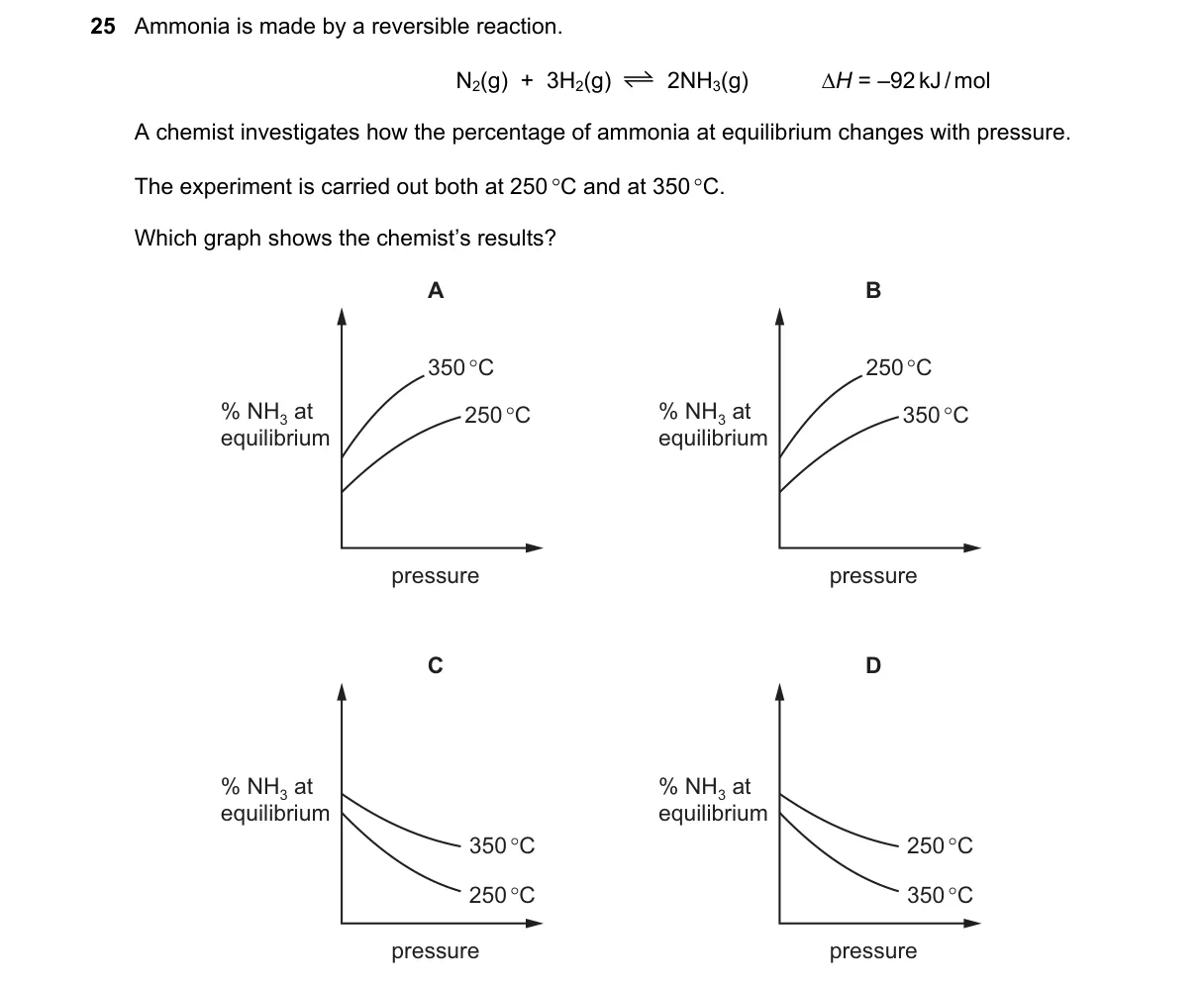
Answer choices
- AOption A
- BOption B
- COption C
- DOption D
Explanation
Le Chatelier's principle predicts pressure and temperature effects on ammonia yield
Steps:
- Reaction has fewer gas moles on product side (1 vs. 4), so higher pressure shifts equilibrium right, increasing % NH₃.
- Exothermic forward reaction (ΔH negative), so higher temperature shifts equilibrium left, decreasing % NH₃.
- At 250°C (lower T), equilibrium favors products more, so % NH₃ starts higher and rises faster with pressure.
- At 350°C (higher T), % NH₃ starts lower and rises more slowly with pressure.
Why B is correct:
- Matches Le Chatelier's principle: steeper % NH₃ increase at lower temperature due to greater exothermic favorability.
Why the others are wrong:
- A: Reverses temperature effect, showing higher yield at 350°C.
- C: Ignores pressure effect, showing flat or minimal change.
- D: Inverts pressure trend, decreasing % NH₃ with higher pressure.
Final answer: B
Topic: Reversible reactions and equilibrium
Practice more O Levels/IGCSE Chemistry (5070) questions on mMCQ.me