O Levels/IGCSE Chemistry (5070)•5070/12/O/N/21
O Levels/IGCSE Chemistry (5070) — 5070/12/O/N/21, Question 21
Which statement is correct for all reversible reactions that have reached dynamic equilibrium?
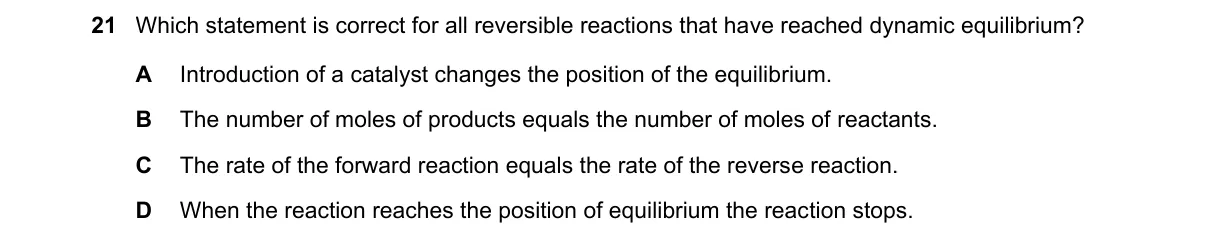
Answer choices
- AIntroduction of a catalyst changes the position of equilibrium
- BThe number of moles of products equals the number of moles of reactants.
- CThe rate of the forward reaction equals the rate of the reverse reaction.
- DWhen the reaction reaches the position of equilibrium the reaction stops.
Explanation
Dynamic Equilibrium in Reversible Reactions
Steps:
- Define dynamic equilibrium as the state where forward and reverse reactions occur at equal rates, with no net change in concentrations.
- Evaluate option A: Catalysts speed both reactions equally but do not shift equilibrium position.
- Evaluate option B: Equilibrium depends on equilibrium constant, not equal moles of reactants and products.
- Evaluate option C: Matches the core definition of equal forward and reverse rates.
- Evaluate option D: Reactions continue dynamically, not stopping.
Why C is correct:
- By definition, dynamic equilibrium requires the rate of the forward reaction to equal the rate of the reverse reaction, ensuring constant concentrations.
Why the others are wrong:
- A: Catalysts affect activation energy equally for both directions, leaving equilibrium position unchanged (Le Chatelier's principle).
- B: Mole equality is not required; it varies with the equilibrium constant K.
- D: Equilibrium is dynamic, so reactions persist at equal rates without stopping.
Final answer: C
Topic: Reversible reactions and equilibrium
Practice more O Levels/IGCSE Chemistry (5070) questions on mMCQ.me