O Levels/IGCSE Chemistry (5070)•5070/12/O/N/21
O Levels/IGCSE Chemistry (5070) — 5070/12/O/N/21, Question 1
In a titration, 25 cm³ of aqueous sodium hydroxide is transferred into a conical flask. A few drops of indicator are added. Dilute hydrochloric acid is then added to the flask until the end-point is reached. Which pieces of apparatus are used to measure volume in this experiment?
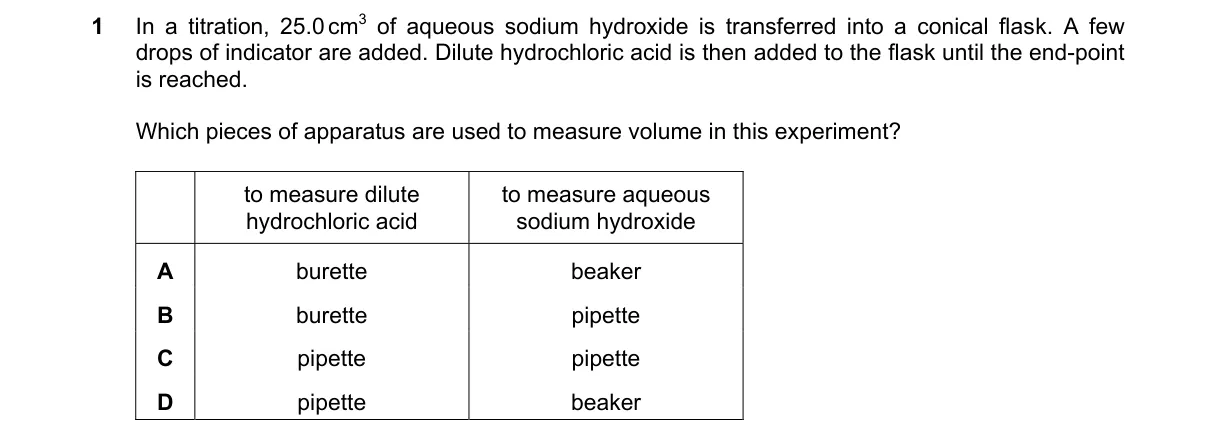
Answer choices
- Aburette to measure dilute hydrochloric acid, burette to measure aqueous sodium hydroxide
- Bburette to measure dilute hydrochloric acid, pipette to measure aqueous sodium hydroxide
- Cpipette to measure dilute hydrochloric acid, pipette to measure aqueous sodium hydroxide
- Dpipette to measure dilute hydrochloric acid, beaker to measure aqueous sodium hydroxide
Explanation
Standard titration apparatus for volume measurement
Steps:
- Pipette delivers a precise, fixed volume of sodium hydroxide (25 cm³) into the conical flask.
- Add indicator to the flask for endpoint detection.
- Burette dispenses variable volumes of dilute hydrochloric acid incrementally.
- Record the burette reading at the endpoint to determine acid volume used.
Why B is correct:
- In acid-base titration, the pipette measures the exact volume of the base (analyte), while the burette allows precise control and measurement of the acid (titrant) volume added.
Why the others are wrong:
- A: Sodium hydroxide is pipetted, not measured with a burette, which is for the titrant.
- C: Hydrochloric acid requires a burette for variable dispensing, not a fixed-volume pipette.
- D: Beaker lacks precision for measuring sodium hydroxide; acid also needs a burette, not a pipette.
Final answer: B
Topic: Acid–base titrations
Practice more O Levels/IGCSE Chemistry (5070) questions on mMCQ.me