O Levels/IGCSE Chemistry (5070)•5070/11/O/N/21
O Levels/IGCSE Chemistry (5070) — 5070/11/O/N/21, Question 6
An aqueous solution of zinc chloride is tested by adding reagents. Which observation is correct?
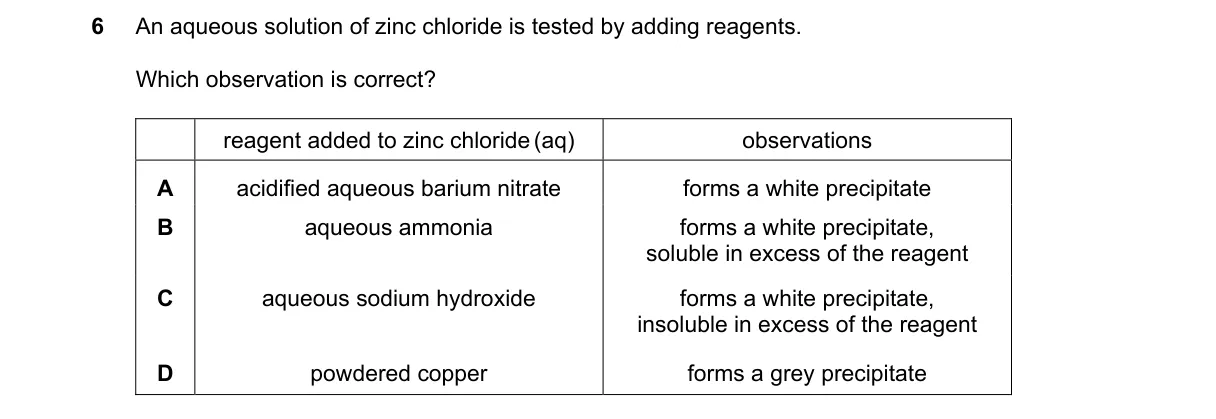
Answer choices
- Aacidified aqueous barium nitrate (aq) forms a white precipitate
- Baqueous ammonia forms a white precipitate, soluble in excess of the reagent
- Caqueous sodium hydroxide forms a white precipitate, insoluble in excess of the reagent
- Dpowdered copper forms a grey precipitate
Explanation
Zinc ion test with ammonia
Steps:
- Identify Zn²⁺ as the cation in zinc chloride solution.
- Recall standard qualitative tests for Zn²⁺ ions.
- Apply ammonia test: forms Zn(OH)₂ white precipitate, dissolves in excess NH₃.
- Match to options, confirming B's description.
Why B is correct:
- Zn²⁺ + 2NH₃ + 2H₂O → Zn(OH)₂ (white ppt), then excess NH₃ forms soluble [Zn(NH₃)₄]²⁺ complex.
Why the others are wrong:
- A: Barium nitrate precipitates sulfates as BaSO₄; no sulfate in ZnCl₂, so no reaction.
- C: Zn(OH)₂ dissolves in excess NaOH to form [Zn(OH)₄]²⁻ zincate ion.
- D: Cu metal does not react with Zn²⁺; Zn is more reactive, no displacement or precipitate.
Final answer: B
Topic: Identification of ions and gases
Practice more O Levels/IGCSE Chemistry (5070) questions on mMCQ.me