O Levels/IGCSE Chemistry (5070)•5070/11/O/N/21
O Levels/IGCSE Chemistry (5070) — 5070/11/O/N/21, Question 24
In a neutralisation reaction, which change in particles occurs?
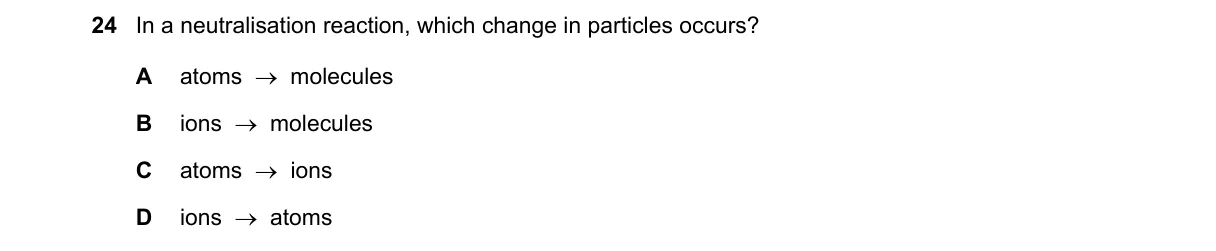
Answer choices
- Aatoms → molecules
- Bions → molecules
- Cions → ions
- Dions → atoms
Explanation
Neutralization Converts Ions to Molecules
Steps:
- Neutralization is the reaction of an acid and a base to form salt and water.
- Acids release H⁺ ions; bases release OH⁻ ions in solution.
- H⁺ and OH⁻ ions combine to form H₂O molecules.
- Overall, ionic reactants produce molecular products like water.
Why B is correct:
- Neutralization involves H⁺(aq) + OH⁻(aq) → H₂O(l), where ions form neutral water molecules.
Why the others are wrong:
- A: Neutralization starts with ions, not free atoms.
- C: Ions react to form molecules, not just exchange into new ions.
- D: Products are molecules like water, not atoms.
Final answer: B
Topic: The characteristic properties of acids and bases
Practice more O Levels/IGCSE Chemistry (5070) questions on mMCQ.me