O Levels/IGCSE Chemistry (5070)•5070/11/O/N/21
O Levels/IGCSE Chemistry (5070) — 5070/11/O/N/21, Question 22
Two solutions are prepared. • Solution P is 0.50 mol/dm³ hydrochloric acid. • Solution Q is 0.10 mol/dm³ butanoic acid. A 2 cm strip of magnesium ribbon is put into 100 cm³ of each solution. Fizzing is seen in both solutions but the fizzing is faster in solution P than it is in solution Q. Which statement helps to explain this observation?
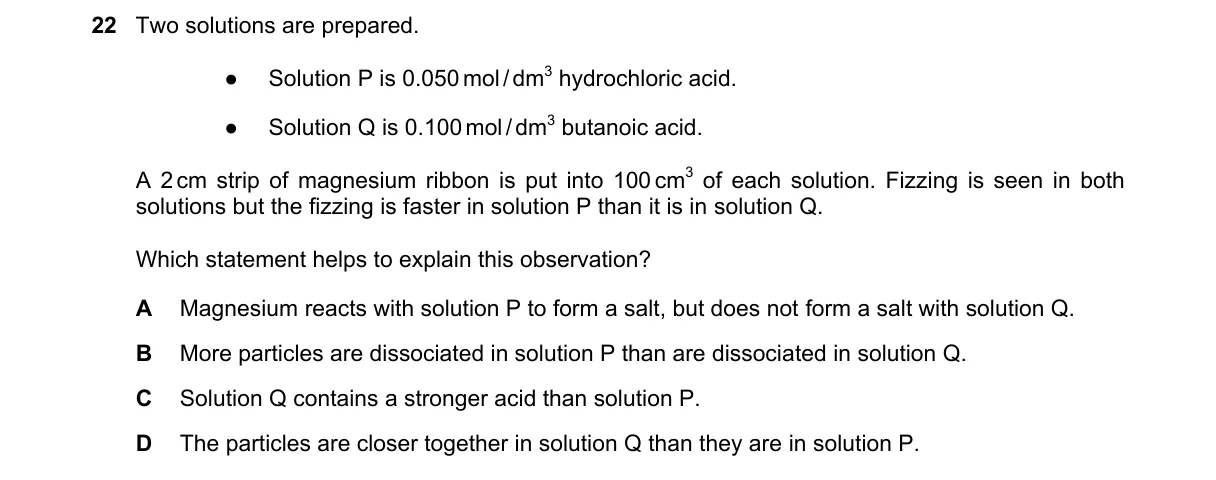
Answer choices
- AMagnesium reacts with solution P to form a salt but does not form a salt with solution Q.
- BMore particles are dissociated in solution P than are dissociated in solution Q.
- CSolution Q contains a stronger acid than P.
- DThe particles are closer together in solution Q than they are in solution P.
Explanation
Reaction rate depends on H+ ion concentration from acid dissociation
Steps:
- Identify acids: HCl is strong (fully dissociates), butanoic acid is weak (partially dissociates).
- Compare concentrations: P has 0.50 mol/dm³ HCl (all H+ ions), Q has 0.10 mol/dm³ butanoic acid (fewer H+ ions).
- Reaction: Mg + 2H+ → Mg²+ + H₂ (fizzing from H₂ gas); rate increases with [H+].
- Observation: Faster fizzing in P due to higher [H+] from full dissociation despite lower volume.
Why B is correct:
- Strong acids like HCl fully dissociate, providing more H+ ions per mole than weak acids like butanoic acid, increasing reaction rate with Mg.
Why the others are wrong:
- A: Both acids react with Mg to form salts (MgCl₂ and magnesium butanoate).
- C: HCl in P is stronger than butanoic acid in Q.
- D: Particles (ions) are more concentrated in P (0.50 mol/dm³ vs. 0.10 mol/dm³).
Final answer: B
Topic: The characteristic properties of acids and bases
Practice more O Levels/IGCSE Chemistry (5070) questions on mMCQ.me